Friday, October 19, 2018

Folk Fights Back - Coventry's CVfolk Inaugural Live Event in bid for City of Culture Status.

Folk Fights Back - Coventry's CVfolk Inaugural Live Event in bid for City of Culture Status.


At a time when young Teesside folk acts like Megson, Cattle and Cane, The Younguns are reinventing what folk music can be, filling venues around the country, and getting write ups in the Guardian and Independent, the Coventry folkscene is fighting back and celebrating its own historic and dynamic folk culture that has attracted the likes of Joe O'Donnell, Dave Swarbrick and many others to the City and boasts a range of singer songwriters giggling around the country. With Selecter star Pauline Black as patron, Pete Willow is working hard to put Coventry folk on the map!

Pete Clemons reports from CVfolks inaugural Live event..


Coventry singer Songwriter Kristy Gallacher

Folk music does seem to get a raw deal in the CV area. It has been all but forgotten about by most of the local media outlets. Despite several attempts to get coverage revived, they simply just don’t seem to want to know. It does all smack of being a bit un-cultural like, in my opinion.

So rather than sit around and dwell about it, and in true tradition of the genre, it has taken things into its own hands and began to fight back. A group of big hitters within the scene have set up an organisation called CVFolk with the aim of ‘Promoting Folk Music and Dance in Coventry, the 2021 UK City of Culture’.

Taken from their website ‘CVFolk is a campaign to provide resources and co-ordinated events for folk music and dance in and around the CV postcode area. It encompasses two strands: Legacy and vision’.

And those aims were fully realised at CVFolk’s inaugural live event set in the foyer of the Albany Theatre on Sunday 14th October.

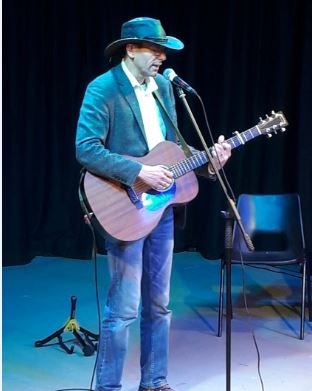
The message I took away from this particular session was that the format will combine the traditional folk scene with the more modern singer songwriters. Enforcing that point, the line-up for the event was The Willow and Tool Band, Poachers Pocket, Kristy Gallacher and Rob Halligan. Shoehorned in between the first and second halves we were even treated to a few minutes of clog dancing.

Rob Halligan and Kristy Gallacher are no strangers. They once recorded a song together for the 2004 Tsunami disaster in Asia that cracked the top 20 indie charts which raised in excess of 13k for the fund. For this evenings session they shared the top billing by alternating with each other. Each tune they played was accompanied by some background information about how the song was arrived at. Kristy’s set included the heartfelt Spinning Plates, Plan B and Fending off the Frost while Rob powerfully performed Hold You Tonight and Wild Horses.

‘Music has the power to tell stories in a way that connects with people’ says Rob on his website. And that is so very true. Rob, for example, mentioned the fact he is originally from Worthing. And a couple of the songs he played were based on his experiences of his time there.

One of those songs was called Dancing with Seagulls. And the lyrics were so vivid. They recalled how, as a youngster, he would visit the beach and terrorise the flocks of snoozing seagulls by running straight through them scattering them into the air. This immediately took me back a few weeks to the balmy summer and when we took our grandson to the seaside. I was like a Cheshire cat as I recalled how he had found it great fun doing the very same thing. Not so sure the seagulls appreciated it though. Similarly, when Kristy sang the incredibly touching and sensitive Beautiful Bouquet, this also found resonance with me. I actually found myself misting up as it transported me back to a whole different time and place. Trust me, not only are these songs so very very good, they are also very powerful.

Despite one or two technical issues with guitar leads, the whole event flowed fairly seamlessly. And given that the event was staged in the 
in the Albany’s new Studio Theatre, and not the main theatre, the sound inside the venue was surprisingly impressive too. 

In a closing statement, patron of this campaign Pauline Black, summed things up perfectly when she reminded us of her own humble roots as a folk singer at the Dyers Arms, some 100 yards from this venue, and how that played an important and vital role in the development of her craft. 


Click to read about Pauline Black's background with Coventry folk clubshttps://coventryfolkclubs.blogspot.com/2013/04/pauline-black-on-coventry-folk-scene.html

Further installments of this venture will take place once a month, with the next live event scheduled for November 11th when Rosie Hood will headline. More details can be found on the link below……….. 


NB Apologies to Loz of the Albany, Pete originally said the event was in the Foyer but was actually in the Albany’s new Studio Theatre, mistake corrected now in the text. Trev (Admin).

Visit CVfolk's website
http://www.cvfolk.com/


Coventry Singer Songwriter Rob Halligan


CV Folk Patron Pauline Black


Pete Willow and Pete Tool


Joe O'donnell's Shkayla 


Lady Baby Gypsy Queen - Rod Felton from Rod Felton - Singer Songwriter on Vimeo.

Friday, October 12, 2018

The Sorrows 1965

The Sorrows 1965
by Pete Clemons


The recent loss of bass player, and founder member of Coventry band The Sorrows, Phil Packham, has had me delving into the bands fascinating past. Phil himself was incredibly proud of his achievements. And rightly so as The Sorrows hold the distinction of having had the first LP release by a Coventry band. The album, titled ‘Take a Heart’, contained the hit single of the same name along with earlier singles along with other original tunes and was released toward the end of 1965. Make no mistake, this was seen as a big deal at that time.

It had been a complete turnaround in fortunes for The Sorrows. Weeks before the album’s release it looked all over for the band due to legal rifts being dragged out. Their debut 45 ‘I Don’t Wanna be Free’ had been reported as lacking originality. It really was touch and go for the band. ‘We were fed up and began to doubt if we would ever make it’ said the bands lead singer Don Maughn (later Fardon) at the time.

But then, after the low key release of the single ‘Baby’, ‘Take a Heart’ was released. In the UK, advance sales of 15,000 copies made it a chart certainty. And so it happened as the record almost cracked the top 20.

The follow up to the ‘Take a Heart’ 45, ‘You’ve Got What I Want’, totaled 10,000 plus in advanced sales. This was sufficient for it to get a top 50 placing. The Sorrows were convinced that it would be more successful than ‘Take a Heart’ which was, later on in 1965, released in the U.S. and thirteen other countries.

During the week of the L.P. release lead singer, Don Maughan, gave a frank an honest interview about each track on the record, giving some surprising and forthright comments. As a point of interest, that same week the ‘Take a Heart’ LP was released the single of the same name reached number 2 in Japan and number 4 in Poland.

Here are some of the comments from Don’s interview:

Baby: Don said ‘I still like this one a lot. People say to me that Baby is better than Take a Heart. You see what the right plugs can do. Baby was equally ambitious but the plugs weren’t there and it failed to get off the ground’.

No No No No: Don said ‘Pip Whitcher our lead guitarist and I wrote this one. We've now got our own music publishing firm you know. It’s called PipDon’.

Take A Heart: Don groaned ‘Take it off, this bores me now. But don’t get me wrong. This has enabled us to put down the deposits on nice houses of our own. I'm bored of it now, but very grateful’.

She’s Got the Action: Don laughs ‘Miki Dallon, who wrote our hits, penned this one. But it’s known as a filler, just thrown in to fill the L.P. up. Honestly, it is really shocking. Sounds as if we made it up as we went along’.

How Love Used to Be: ‘This is an unusual quieter side to The Sorrows’ says Don. ‘It’s different to our usual belters. Restrained, even gentle. At first I had my doubts but now I feel very pleased with this. That odd guitar sound is Pip and Wes (Price) playing in very close combination. At first I wanted to have strings and things behind us on this but John Schroeder, our recording boss, said no’.

Teenage Letter: Strangely there were no comments against this.

Side two begins with I Don’t Wanna be Free – The Sorrows first disc: ‘This sounds dated now and lacks originality. Too like The Kinks’ says Don. At first I liked it but now I don’t blame people for not buying it’.

Don’t Sing Me No Sad Songs: ‘This is very unusual for The Sorrows, the most surprising track on the album. It is on the controversial Bob Dylan kick with folksy half sung, half spoken vocalising’.

Caralin: ‘This drum dominated track is the cover of an American hit by The Strangeloves. I am pleased with this one too. Nice recording quality on the drums. Without being big headed I think it is as good, if not better, than the American original’.

We Should Get Along Fine: ‘Pip and I wrote this. Okay at first, it drags now’.

Come With Me: ‘Another we wrote ourselves. That imitation of Donald Duck is by bass player Phil Packham. It is the best part of the track. It was the ‘B’ side of our first single and really sounds like a ‘B’ side too’.

Let Me In: ‘There is a row over this one’ says Don. ‘It is the best number on the L.P. but we all reckon John Schroeder has wrecked it by over recording. It sounds like a hundred guitars all playing at once. We were going to make this a single until we heard the recording quality. A great pity because the number itself is very strong’.

Don and Phil both left The Sorrows during 1966 and a whole new chapter began for the band that in itself was fruitful. Thanks for the memories guys.


More articles on The Sorrows by Pete Clemons on this blog - 

Friday, October 5, 2018

Dissolution - The Pineapple Thief

Dissolution - The Pineapple Thief 

by Pete Clemons


‘Writing is in full swing for the new The Pineapple Thief record here at Soord Studios. Today I’m using this lovely (and pretty rare!) baritone Telecaster. And no I didn’t buy it. Thank you Godsticks for letting me steal it.’

‘I'm back from my 6 months of self-imposed exile while writing and recording the new The Pineapple Thief album. It's been an absolute mammoth undertaking for all of us and I for one can't wait for you all to hear it. In the meantime, I've just a few teeny tiny tweaks to make before handing over the concoction to Steve (Kitch) for mastering.’

These were just some of the messages that were appearing on social media, earlier this year, from the writing and recording process for what became The Pineapple Thief’s latest album ‘Dissolution’.

When he began to surface I took the opportunity of asking Bruce how recording was going and if there had been any major changes in approach from the last album. He replied: ‘no nothing different to ‘Your Wilderness’. Although this time we were sharing ideas and developing songs. So Gavin would try things on drums, then I would take what he did and try things in my studio. And we'd all keep sharing ideas and chatting online as the album progressed. It got quite intense at times, but in a good way!’

‘The band recorded Dissolution across the UK, sharing ideas via instant messaging’ was another message I picked up on via the web site belonging to The Pineapple Thief’s record label ‘K.Scope’.

And here is where the irony begins as guitarist and primary songwriter, Bruce Soord, freely admits. The album was created with modern technology and the heavy use of social media yet the overriding theme of ‘Dissolution’ stands as a warning as to how we use it.

On early listens ‘Dissolution’, I think, comes across as not as ‘edgy’ an album than more recent releases by The Pineapple Thief have been. However after multiple plays of it you discover that the beauty and the edginess is in its detail. ‘Dissolution’ is very subtle and far more dynamic than anything I have heard from The Pineapple Thief before. The music may not be as incisive but the messages contained within it are, for me, incredibly powerful and thought provoking. Gavin Harrison is very evident on the record. He is credited as having contributed on almost every song. One of the rare times when, I think I am correct in saying, where Bruce Soord has not been referenced as the sole writer.

The Pineapple Thief’s music is a journey of evolution as they continue to explore new territory. And they have certainly traveled some distance from their early records. As mentioned, the subject matter this time around is the internet, social media and our use of it. I have shamelessly cut and pasted the following paragraph from an interview Bruce Soord gave recently. It gives great insight as to what motivated him to write the album and where the ideas came from……….

Thematically, Pineapple Thief albums have been quite similar in that I’m always writing about the human psyche in the context of this society that I’ve grown up in, and in the changing society that I’m growing up in. And it’s really, really changed so much over the last five years, maybe even the last two years, the sort of technological revolution that we’ve lived through. And I think that when history looks back on this time and reassesses what we were doing, what we’re doing right and what we were doing wrong, I think that they will admit that a lot has gone wrong. It’s a bit like an addiction, you know, it’s a bit like a drug, like alcohol, or heroin or cocaine. Nobody really knows when it’s a problem because it’s so new. And it’s only now that big tech companies are talking about addiction, smartphone addictions and the mental health problems that children are growing up with. I mean, it certainly affected my mental health…I’m not saying that I’ve gone crazy or anything, but being connected to so many people, to so many things, to having access to so much information, so many opinions is just unnatural and exhausting. And as a musician, it goes one step further, because you are connected to all of your listeners. You get an insight into what they think about you, and some of these things are just horrible as well. Some of the lyrics on the record, the very first track, ‘Not Naming any Names’ is specifically about those people, the people that just want to weaponise social media and these connections and cause people harm. So as a musician growing up in these times, you’ve got to have a thick skin and if people want to do what we do and get your music out there, you’ve got to be prepared to take it. To understand that it’s a battleground out there in many ways. But yes, that’s what it is, that’s the theme that connects the entire record.

The band has just returned home after a successful tour of Europe. A few UK dates are to follow along with a return to Europe in 2019. I have also read America as being a possible destination. It has taken 20 years to get to this point, and, right now, and in among them all a little man is standing so very very tall.


Thursday, September 27, 2018

From the Sun / Bitter Suite

From the Sun / Bitter Suite
by Pete Clemons


The reason for putting together these few words was to recognise and remember a couple of Coventry bands from the mid to late 1960s. In fact October 2nd marks 50 years from when one of them recorded. Information on these bands is understandably difficult come across given the passage of time. But there is one cutting from the archives of Colin Williams featuring ‘From the Sun’ and which I have faithfully reproduced.

‘After exiling itself for the past year a Coventry group – restyled with a new sound – is bouncing back into the city scene.

The five man group ‘From the Sun’ was formed toward the end of 1966 with a ‘soul’ base to its material. But Coventry has seen little of the group, which found itself a ready market for its talents in clubs and pubs all over the North.

About the nearest the five got to their Coventry homes was a fortnightly spot, since last Easter, at Chesford Grange. But that stay away plan is changing. On Saturday night the group appeared at the Walsgrave Inn, where the five are booked to appear again, with the Ray King Soul Band next Thursday.

Present line-up is singer Mick O’Rourke: organ Tony Warner: drums Rick Sparke: bass guitar Reg Sparke and lead guitar Colin Williams. And the three pictured above – at the Walsgrave – are Reg, Mick and Colin.

The group, which writes some of its own material, is switching to a new sound. Colin, who handles music arrangement, said: ‘We used to be a soul group. But now we’re trying out new material with a very free-form basis. It’s a sort of cross between blues and American west coast’.

Bitter Suite was a short lived Coventry band.


As lead guitarist Colin Williams recalls ‘I think we probably got together during the summer of '68, but never, as far as I can remember, did any gigs’.


But here is some information on "Bitter Suite" that I have managed to gather and put together.


The band recorded four tracks at Hollick & Taylor studios in Birmingham on 2nd October 1968. These were titled:


Wild Waters

The Cat

Evergreen Wood

Bride Of The Winds


Personnel on these recordings were:

Alan Payne on keyboards

Mick Keel on Bass Guitar

Kevin Connolly Drums

Colin Williams Guitar

--------------? Vocals


Afraid that the singers name remains a mystery. Nobody seems to remember his name only that he was from Birmingham, and sang with another lad previously, as a duo.


As for the other member of Bitter Suite, Mick Keel played bass in a number of Coventry bands, The Soul Express being one of them. Kevin Connoly played drums for The Chicanes and Alan Payne played for The Flamingoes. Colin Williams would go on to pay for Indian Summer.

....................
Additional material

From the Sun

Psychedelic group or rather blues and free form.

Line up: Mick O'Rourke (vocals), Colin Williams (guitar), Tony Warner (organ), Reg Sparke (bass), Rick Sparke (drums). (The original singer Pete ? was replaced by Mick O'Rourke from The Gazelles.)

Formed towards the end of 1966 as a soul band, but quickly switched to their own material. Colin Williams, who was the arranger described the group as '..trying out new material with a very free-form basis. It's a sort of cross between blues and American West-Coast'.

Mick O'Rourke was also in The Gazelles and The Image.

Colin Williams later in Indian Summer.


From Pete Clemons http://coventrygigs.blogspot.co.uk/2014/04/colin-williams-indian-summer.html

"Began following on from Soul sect with R & B and soul, playing in clubs and pubs all over the North East of England. British blues was in its infancy but Colin became more influenced by Eric Clapton and John Mayall (with Peter Green) and Ainsley Dunbar. From the Sun restyled themselves with new vocalist Mick O'Rourke (after original vocalist Pete, had moved on). They went on to forge a new sound. They played local venues like the General Wolf, Walsgrave and Plough with the sound of blues and a more free-form sound. They began playing some of the things that Colin had written and were also influenced by some of the things coming from the west coast of America. They gained a reputation for being one of the hottest and most creative bands in the city.

This photo of Tony Warner is from his daughter Haley Warner.


Photos from Sharron Flanagan


Monday, September 24, 2018

Old Skool - Crokodile Tears

Old Skool - Crokodile Tears

By Pete Clemons


Regardless of whether you enjoyed it or not, schools tend to hold many memories. They are the places where many of your childhood secrets happened. You may have met a best friend at school, got into that first scrape or you may even have had your first crush there. Then there are the pranks you played and the silly stories and jokes.

These are lifelong memories. And as we grow older, perhaps in those quieter moments, we often look back on them with wonder. Something may spark an ‘I wonder whatever happened to so and so’ moment. What are they doing now? A song or a situation may trigger a memory, or someone may say something that has you thinking back many decades to a funny situation, and you suddenly get a daft grin on your face which you have to explain away. I am sure we have all done it.

Well Crokodile Tears, namely Alf Hardy, Jerry Richards and Christopher Sidwell, are back with an album called ‘Old Skool’ that explores this very subject. Even the sleeve show primary song writer, Christopher Sidwell, looking back and reminiscing on a previous life over the landscape where Binley Park School once stood.

Right from the albums opening tune ‘Kids‘, you really do find yourself in a reflective mood. Admittedly it is childlike at times but this album is not all about childhood whimsy. Christopher has attempted to inject some seriousness throughout it all. Tunes like ‘End of an Error’ attempts to remind us of the values we once held. Even the homage paid to one of England’s greatest footballers – Bobby Charlton – contains a strong message. We once smiled about it but if you ever feel the need for a comb over, then you have one. It’s absolutely your right to. And as with all ‘Croks’ songs, humour is not far away either.

There is a great mix of songs on here too. Some of the songs start with the chorus, so effectively back to front, as far as traditional song writing goes. ‘Kosmic Popadom’ was born out of a spontaneous jam. Jerry Richards contributes with an instrumental called ‘Doctor Dee’ and the listener is also treated to a Beatles cover. The one common denominator being that all the songs are deliberately kept on the short side. Most of the tunes are running in at between 2-3 minutes each.

Many of our local luminaires are credited for the albums creation including Keith Fabrique for pre-production and engineering and Paul Sampson, who oversaw the production of the project. In fact this that Paul and the ‘Croks’ have worked together since the band’s debut album around 35 years ago. And the team work certainly pays dividends in producing a consistency of sound across the entire album.

Overall this album is a delight. It’s all a joy and, above all, it is pure escapism. And it is guaranteed to have you recalling long forgotten memories. Also, stick with the album to the very end, and you will even find an additional hidden bonus track.


Old Skool - Crokodile Tears on Deezer


https://www.deezer.com/us/album/71088282

Wednesday, September 12, 2018

Soft Machine

Soft Machine

by Pete Clemons


As I was growing up, like many, I was often derided for the kind of music that I listened to. You were often viewed as a bit of an oddball if you diversified away from what the normal media offered. It sounds bizarre now but even within the company of your own peers you could have been viewed as a bit strange for exploring other avenues from what they were listening to.

One band who, for me at least, certainly fitted into the latter category, were The Soft Machine. Yet for as long as I remember I have always enjoyed listening to them. For me, The Soft Machine’s music is timeless and this year see’s the current version of the band celebrating 50 years since the release of the debut Soft Machine album.

From their formation in 1966 the amount of personnel changes within the Soft Machine numbers, I am guessing, in the thirties. And a line-up that includes John Etheridge on guitar, Roy Babbington on bass, John Marshall drums and Theo Travis flute are about to take to the road to undertake an extensive U.S. and European tour.

In addition the band have dropped the ‘Legacy’ tag that they have used for at least the last ten years and recorded a new album, ‘Hidden Details’.

Soft Machine evolved from Kent based band The Wilde Flowers during 1966. Their initial line up consisted of Mike Ratledge keyboards, Robert Wyatt drums, Kevin Ayres bass and Daevid Allen guitar although Daevid left the band quite early on. From the start they were a band with no restrictions. Music began as rock based although later recordings drifted increasingly towards jazz.

As described by Robert Wyatt ‘we were musical misfits from Canterbury. At the time the band was formed I was the only drummer around and Mike Ratledge was the only keyboard player around. And there was nobody else around like Kevin Ayres – a unique guy. Had we have come from a big city then things might have been different as there may have been an abundance of musicians to pick from’. They had been ejected from local pubs due to the length of their hair.

They were all very experimental sorts of people and the idea was that they had to get themselves into a zone. Dig into a groove, if you like. With a receptive audience before them, ‘The Softs’ would take them all to another place. Robert Wyatt jokes that the idea was not to stop in case they got boo’d for what they were doing.

The band was influence by John Coltrane and his workouts. They shared this love for a mix of jazz and improvised rock which was not on predictable lines. Wyatt has since mentioned that the name ‘Soft Machine’ came courtesy of Mike. Although it seems that it was Kevin Ayres who got ‘the Softs’ their first deal with Chas Chandler.

And it was through this association that ‘The Softs’ toured the US with Jimi Hendrix during 1968. In fact it became two particularly difficult tours. Even the band’s debut album was recorded during their time in the US. The second tour even saw Andy Summers, later of the Police, briefly joining the trio. Such was the stress that toward the end of 1968 ‘The Softs’ had disbanded with Kevin Ayres skipping off to Spain.

However a month or so later, during December 1968, Robert and Mike reassembled the band with the addition of bass player Hugh Hopper who also doubled up on sax. Together they recorded the Soft Machine’s second album over February and March 1969. This record would be released in the September of the same year.

But the introduction of Hugh Hopper into the band would also be the beginning of ‘The Softs’ moving away from the song based music they had so far created. By April of 1969 Brian Hopper, the elder brother of Hugh, was appearing regularly on stage with Soft Machine playing sax.

At this point I would greatly recommend the heavily bootlegged ‘Live at Paradiso’ album. Recorded March 1969, for me it captures Soft Machine perfectly, right in between their past and what would become their immediate future.

Toward the end of 1969 alto sax and saxello player Elton Dean, who had been a member of the Keith Tippet band, was also appearing with the band as Brian Hopper moved away from the live performances.

During a 1997 interview Mike Ratledge gave an insight into this period: ‘Hugh, myself and Elton were pursuing a vaguely jazz-related direction. Robert was violently opposed to this, which is strange looking back on it because he was passionate about jazz. But he had defined ideas of what pop music was and what jazz was.’

Robert Wyatt has since said ‘To me, fusion jazz was the worst of both worlds. It was rock rhythms, played in a rather effete way, with noodling, very complicated solos on top.’

Regardless of what the private thoughts of this new direction were but Robert stayed long enough with the band to create what many consider their finest hours, this being the albums, ‘Third’ and ‘Fourth’. Robert Wyatt would ultimately leave Soft Machine during the middle of 1971.

Then began a period where a plethora of musicians passed through the ranks of Soft Machine. These would include Marshall and Babbington, from the current line-up along with composer Karl Jenkins who is more well-known nowadays for his classical work.

Yet despite these changes, whoever has been involved with Soft Machine, has consistently provided the listener with a challenge by their unusual jazz structures and free form improvisation. A form of music that simply sounded like no other did. As such I, for one, am really looking forward to hearing the new album. 


Thursday, September 6, 2018

Godiva Festival 2018

Godiva Festival 2018

Memories of a free festival………………

by Pete Clemons


Firstly, thanks to all those involved in creating this wonderful spectacle. One of the on stage announcements that resonated with me was how hard the stage crew had been working. Well beyond midnight each evening and they were back on it at 7:30am every morning. We in Coventry are blessed to have this event on our doorsteps.

The Friday evening was, I thought, very flat in terms of attendance. Despite being a glorious evening weather wise, audience numbers were noticeably down on previous years. But as the weekend progressed, the weather picked up, and in came the revellers, with Saturday and Sunday getting a sizeable crowd.

Jimmy Kemp: The opening act for the whole event on Friday evening. Such was the sparseness of audience initially that, at one point, Jimmy mentioned that he had played to more people in the city centre. Which was a pity as, for me, Jimmy was one of the highlights of the entire festival. His set included some own gems such as ‘Perfect Day’ and ‘If I Could Live My Life Again’. Then, instead of plugging more of his own music, he gave us a rendition of ‘Hey Jude’ as he thought we would enjoy it more.

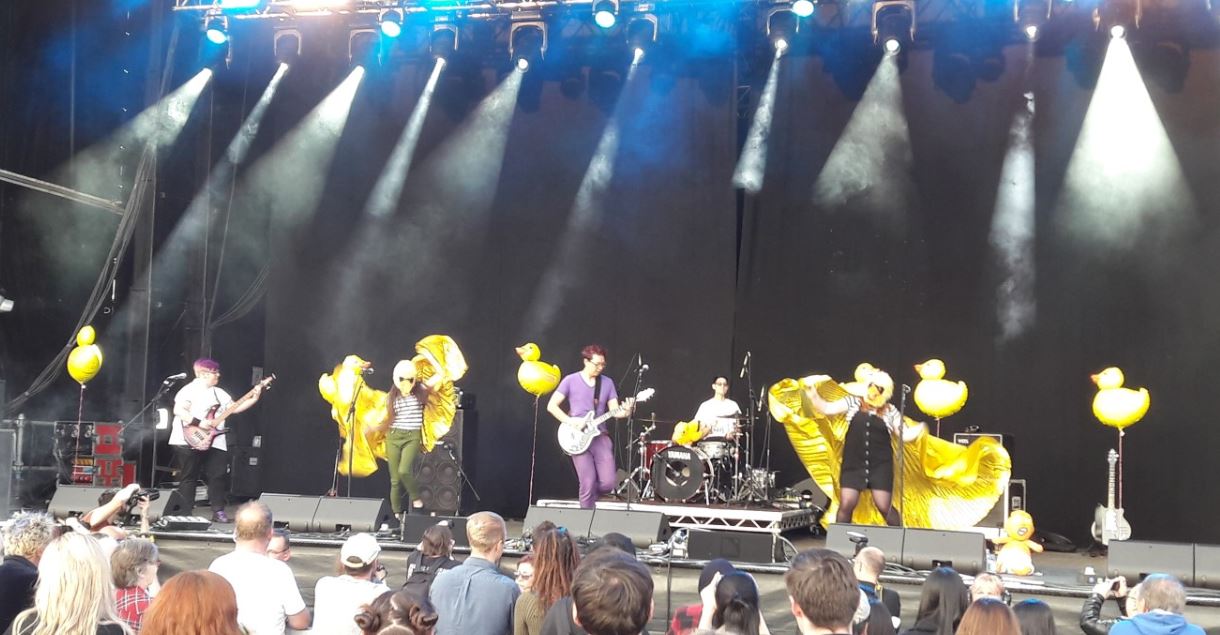
Duck Thieves: From the sublime, we were then treated to a novelty band in the form of Duck Thieves. It has to be said that they were full of up lifting messages and with tunes such as ‘Why Should I Look Like Everyone Else’, ‘Make Babies or Get High’, ‘Dance Like a Duck Thief’ and ‘You Will Never Make it on your Own’ they certainly proved that they could keep hold of your attention. Not only that but they gave you a smile a second.

Matt Cattell: I only really know Matt through social media but he certainly wears his heart on his sleeve. And this enthusiasm has transcended into his song writing. His set was a mix of originals and covers that included several well-known tunes from the 90s such as ‘Lucky Man’ and ‘Wonderwall’. To say his audience shared Matt’s motivation would be an under-statement also.

Ollie Bond: I had never heard of him before but what a great account of himself he gave us. With songs like ‘Postcard from Paris’ and ‘Give it All’ he is certainly a singer songwriter that needs serious investigation.

Tony Christie: A lunch time like I never experienced before. I don’t mind admitting that when I first saw him announced I cringed. How wrong I was. This figure in the white suit was pure class. ‘Walk Like a Panther’, Avenues and Alleyways’, ‘Las Vegas’, ‘Reno’, ‘Daddy Don’t You Walk so Fast’, ‘Mario’ and ‘Amarillo’. They were all there and delivered immaculately. Maybe the sun was getting to me but I thoroughly enjoyed him.

The Ellipses: The opening act for the whole Godiva festival two years ago on the main stage. This time an acoustic set on the BBC CWR stage. ‘Voice of the Potential Me’, ‘Easy Going’ and ‘Cold Cactus’ displayed their strong effectiveness for song writing. But then they stick in a medley, which I get why, but I personally would prefer to hear more of their own original material.

Gospability: There is something about a gospel group that is just so uplifting. Even to a heathen like myself. They finished on their take of Aretha Franklin’s ‘Say a Little Prayer’ which had me unashamedly dabbing my eyes afterwards. My sunglasses, saving me, from further embarrassment.

Hazel O’Connor: Not her first time on the main stage. With an audience visibly swelling Hazel and her backing band, The Subterraneans, delivered an incredibly powerful, composed and polished performance. Her set included the classics ‘Eighth Day’ and ‘Will You’.

Neville Staple Band: An extraordinarily brave performance in what must have been the most difficult of circumstances. The atmosphere from the stage permeated within the audience. It was charged in there. ‘A Message to You Rudi’ was given a whole new poignancy. Amongst others, ‘Ghost Town’, ‘Monkey Man’ and other tunes followed. Not quite sure how Neville and the band pulled that performance off. It must have been emotionally shattering.


The thing about the majority of the bands and artists I have mentioned is that, in the main, music is not their full time career. What makes it all the more remarkable to me is that music is a passion that they fulfil in their spare time. And the music they are creating is their own. It is what burns inside them. Many weekends and weekdays they can be found playing the pubs and clubs in the region. So please continue to give them your invaluable support.

The Godiva festival is without doubt the jewel in the crown of Coventry City’s council. It acts as a showcase for much of the city’s amazing talent. And it is quite possibly the biggest stage they will ever appear on. And this, in turn, may even lead to greater things for them. Long may ‘the Godiva’ continue to be an important date on the city’s calendar.