Monday, May 17, 2021

Jigsaw - 1969


Jigsaw - 1969

by Pete Clemons


When Jigsaw came together the band members had already had already gained experience from groups the likes of The Mighty Avengers, Pinkerton's Colours and The Fortunes amongst others. By mid 1969 Jigsaw had released several singles and were in the studio, recording a fresh one, where they were interviewed.

Interestingly the single failed to materialise, possibly because things were a bit fluid and the band were in between labels. Also the interview was conducted prior to the release of Jigsaw's debut album Leatherslade Farm released on the Phillips label.

Jigsaw had just come from the studio where they had been putting the finishing touches to their new single 'Standing On My Head' written by organist Clive Scott. They all felt that the song was really strong and felt that, after two years together, the recording scene was just starting for them.

Clive commented: 'We feel much happier now that we've got Chas Peate and Alan Keene Music looking after the recording side and the new songs are working out nicely. Mind you, our first single 'One Way Street', did quite well, and got a lot of plays in the discotheques, especially in the Midlands'.

As Jigsaw's act was largely visual, wasn't there a problem trying to select the right kind of material to project the group's image?. 'It is a problem' sad Clive 'but we try not to categorise ourselves musically anyway. We just do what we feel is right for us and hope for the best!'.

The group seems pop orientated, but there is no question of 'selling out', because primarily, they play the way they want to play. Said Tony Britnell: 'We play the kind of numbers we like, but present them in a way that appeals to the audience. So we might do Brian Auger's 'Black Cat' perfectly straight, except that there'd be a tap dance on dustbin lids in the middle of it!'

All the members of Jigsaw have wide musical tastes, ranging from The Nice and the Mothers to Spooky Tooth and Jon Hiseman's Colosseum, and this shows in the variety of material that they play. Clive Scott explained 'Having two saxophones in the group gives us tremendous scope, especially as Tony doubles on harmonica. So we might do a soul number first, then a blues with Tony on harmonica while Kevin Mahon, the other horn man, nips off to change for a comedy piece'.

Comedy and presentation are the group's strong points. Their act had to be seen to be believed, always relying on the unexpected. Fire eating, flame throwing, smoke bombs, interspersed with genuinely funny and skillful comic songs and characterisations. Fred Crun, the folk singer who wrote all of Bob Dylan's songs, and that well known cleric, the Rev. Ian Parsley, were each liable to put in an appearance, and it's not unusual for the audience to witness a concert performance consisting of lead guitar, bass and rhythm balloons. Des Dyer said that all the comedy routines and effects go down a storm, especially with the university and cabaret audiences, but added that they have to be careful when they're throwing flames around.

Jigsaw were an incredibly hard working band who were eventually rewarded for their efforts with the world wide, timeless classic, Sky High.


Additional material from the Hobo Coventry A to Z of bands.


Circa 1966 - 1978 - Freakbeat / Pop source including the press cuttings via the Broadgate Gnome


Clive Scott (organ, vocal), Kevin Mahon (tenor), Tony Britnel (tenor, vocal), Tony Campbell (guitar), Barry Bernard (bass), Des Dyer (drums).

Formed in April 1966 by ex members of The Mighty Avengers (Campbell / Mahon), Pinkertons Assorted Colours (Bernard), The Fortunes (Britnel) and The Transatlantics (Scott).

Main strengths were Scott/Dyer's songwriting talents (they'd previously placed songs with Engelbert Humperdink, as well as The Mighty Avengers).


Although formed in 1966, their debut disc wasn't until 1968.Their second single release was written by Alan Bown, who's own band Alan Bown Set, were label mates on MGM's Music Factory subsidiary. They recorded a number of good Pop/Psych/Progressive singles and albums before a 1975 UK Top Ten, with the unashamedly pop 'Sky High'


See below for more from Des Dyer.

Singles:

A:One Way Street/ B:Then I Found You (MGM 1410 1968)

A:Mr. Job/ B:Great Idea (Music Factory CUB4 1968)

A:Let Me Go Home/ B:Tumblin' (Music Factory CUB6 1968)

A:One Way Street/ B:Coffucious Confusion (Philips 6006112 1970)

A:Lolipop & Goody Man/ B:Seven Fishes (Fontana 600 7071 1970)

A:Keeping My Head Above Water/ B:? (Philips 600 6131 1971)

A:Jesu Joy Of Man's Desiring/ B:? (Philips 600 6182 1971)

Albums:

Leatherslade Farm (Philips 630 9033 1970)

Aurora Borealis (Philips 630 8072 1971)

Broken Hearted (BASF BAG22291075 1973)

I've Seen The Film (BASF BAP5051 1974)

Des Dyer.

"I was in one band previous to Jigsaw with two names. In 1962/3 I started a band with my cousin Dave Hagan, we are the same age and we grew up living next door to each other. We always sang together, and would raid my older brother's record collection to listen to and learn new stuff . We could naturally harmonise together without even thinking about it.

Dave played the euphonium at school and we would go out at Christmas time carol singing, me singing and Dave playing his euphonium. It was a nice sound but we never made a fortune! My brother bought loads of American records and we learned songs by the Platters, the Diamonds, mostly vocal harmony groups, but there was a favourite of ours entitled "Black Leather Trosers and Motorcycle Boots" by a band called "The Cheers", we loved it! We particularly liked the Everley Brothers, Jan & Dean, and the Beach Boys so we thought we'd think of a name relating to the surfing scene, so we called ourselves the "Surf Cyders", pretty ironic as we were slap bang in the middle of the UK about as far from the sea as you can get! We decided to misspell the "Siders" part of the name as "Cyders" because at the time we were getting the taste for cyder by telling the landlord at the off licence part of the local pub we were buying it for our parents. We were of course under age at the time. We thought spelling cyder this way was a really cheeky idea, as there was a reference to alcohol in the band's name, and nobody twigged it! 

The third member of the band was a guitarist called Paul Gunton who Dave knew from his school. He was a year older than us and more streetwise than we were, plus he had tattoos up and down his arms. He liked to play folk music, but we soon persuaded him otherwise and we were soon all singing to his guitar playing. At this stage we hadn't really worked out who was going to play what in the band, but we were so into music we knew we were going to do something. My brother owned an acoustic guitar which he'd tried unsuccessfully to play, so I did a deal with him and swapped my transistor radio for his guitar. I was soon strumming away as I practised incessantly, driving my parents potty. Dave also started to learn guitar so that meant we had three guitarists in the band. This was not very practical so we made a decision that Dave should play bass, Paul would play guitar, as he was the best guitar player, and I would play drums. My dad had played drums in the local skiffle band at the Long Lawford legion and I think it was in my genes because I picked it up quite quickly. I had to save money from my paper round to buy some drums. 

The trouble was I had to buy them piece by piece as I couldn't afford a whole kit. Another friend of Dave's called Russel became our "manager" and he entered us in the "Beat Contest" at the Granada cinema in Rugby. We were horrified as we had only been playing together a few weeks and had only done one gig at the local legion club, and another at the bus man's club at Coventry, plus I'd only managed to buy half a drum kit, so I hadn't even got a bass drum. But Russel was adamant that we should enter, so we did. We decided to play "Walking the Dog" and as a gimmick Paul managed to pursuade his girlfriend to walk across the stage wearing a flimsy top and a short skirt, walking her pet Alsatian dog. On the night I was very nervous, as we were competing with the local established bands that were a lot older than us, and as a result one of my sticks flew out of my sweaty palms straight up into the air, and as luck would have it , it came straight back down again and I caught it. Everybody must have thought that this was all part of the act, as the place went ballistic. 

The judges on the night included members of "The Mighty Avengers", this was later to prove very significant in my future career, "The Mighty Avengers" were Rugby's top group who had released singles, some written by the Rolling Stones Jagger and Richards, and were considered to be gods. Well would you believe it ? WE WON. From that moment everything changed. We were suddenly local celebrities. I remember getting off the bus near my school on the Monday morning after the contest on the Sunday, and walking past the girl's school, I was on my own 'cos I was late for school again, and I heard these girls screaming. I looked across and saw all these girls hanging out of the windows and shouting and screaming at me. Then a whole line of them burst out of a door and ran towards me. I panicked and ran like hell to the safety of the boy's school. I sat down, out of breathe and thought how fantastic this was, I had gone from a kid who nobody noticed to an icon that girls were screaming at. From then on I was definitely hooked on the music business! I received a message, well it was more of a summons really, that Adrienne Cox, known as Ada, from the girl's school next door wanted to see me. She was the most beautiful girl at the school and we started going out together, this was just getting better and better. Russel was really working overtime now, and he manged to get us a regular gig at the Maple Ballroom in Northampton, where we were the support act to some of the top line groups of the time. We played with the Hollies, the Searchers, the Kinks, and Freddy and the Dreamers.

The band gradually went off the surfing sound and played more R&B stuff, and as mine and Dave's tastes changed towards that direction, Paul decided that he wanted to get back to playing folk music, so he split from the band. As luck would have it Adrienne's cousin, Phil Clough was a guitarist, and we asked him to join us. We were getting quite a good reputation and were starting doing more prestigious gigs.

In 1966 the singer from the Mighty Avengers decided to pack it all in and the remaining members of the band carried on under the name "Jigsaw" and conscripted various musicians from other bands in the area to complete the line up. Tony Campbell, who was basically the leader of the band, asked Clive Scott, of "Scott and the Antarctics" (What a name!), to join, and then he persuaded Tony Britnel, ex "Fortunes" sax player to join. They soon gained a terrific reputation and were regarded as the best band in the area. I saw them and thought they were fantastic. Then one night Tony Campbell knocked at my door, and said that Biffo Beach, the drummer was leaving and would I like to join. Well I was flabbergasted, the best band in the area was asking me to join? It was a difficult decision to make, but after many heart searching walks on my own and soul searching conversations with Adrienne I decided to leave my own band and join "Jigsaw." That was my pre - Jigsaw story.

Press cutting from 1967 via the Broadgate Gnome


Saturday, May 8, 2021

Liquid Light Shows

 Liquid Light Shows.

by Pete Clemons.


Liquid light shows are a form of light art that surfaced in the mid 1960s as an accompaniment to electronic music and avant-garde theatre performances. They were later adapted and evolved which added to, and became a staple for, the performances of the massive rock tours of the 1970s and 1980s. In fact, for many bands, a show that includes graphics and visuals still exist today.

This meeting of ideas, brought by the light artists and musicians, seemed to do no harm at all in terms of creativity. The music, the lighting and the ambiance appeared to compliment each other as the ideas bounced around off one another. And the added media publicity, it brought, seemed to further highlight the scene.

A Melody Maker gig review from early 1967, of groups who later became household names, described the ambiance as 'some very groovy picture slides which attract far more attention than the groups themselves, as they merge, blossom, burst, grow, divide and die'. All of a sudden it was no longer relevant that a group could play Wilson Pickett or James Brown songs.

During late 1966 and early 1967 the public was beginning to get worried about all this psychedelia stuff. The News of the World newspaper, that had had a hand in a Rolling Stones drug bust, had now set its sights on these 'freak outs', 'happenings' and 'raves'.

The fumiest part of that infamous  article though was where it mentioned that the headline band had, on one of its gig adverts, described themselves as social deviants. It turned out that 'The Social Deviants' was actually the name of the support band.

Earliest forms of these light shows were essentially home made contraptions. Medical slides paired together. Various colourful liquids were forced between them which were then viewed through a projector supported on a wooden frame.

One of the earliest of these lighting shows was 'The Fantasia Light Circus' who worked with bands such as Pink Floyd, Fleetwood Mac and the Pretty Things at venues like the Middle Earth in London. And one of the creators of the light circus was Mick Brockett who arrived in Germany during 1969 after touring the show around Europe as an independent light show.

During the summer of 1969, Mick teamed up with a band called Prophecy (Nektar without Roye Albrighton) at a week long gig at the Camera Club, in Furth. Prophecy bass player, Derek 'Mo' Moore, attended Mick's show at "Beat Club" in Langelsheim.

Soon after Prophecy became Nektar during November 1969. At the same time, Mo was looking to enhance the Nektar presence on stage. Nektar was definitely looking for something unique to complete the bands psychedelic image so Mick, an admirer of Nektar's sound, joined the group as "light–musician" on January 10th, 1970 in Hamburg.

As Mick learned the music he was more able to choreograph the lights as opposed to just randomly flashing them. As such, Nektar's original light show evolved from the Fantasia Light Circus and featuring Mick Brockett providing the rhythmic liquid, slide light shows, on one large white screen.

Today, Mick Brockett thinks the light shows were prematurely abandoned by the rock world. That said though, many bands have moved on to lasers that skim over the audience.

At times the light show became the center of much attention. With a band like Nektar the lights somehow managed to steal the show from the band. Quite often, they were the most talked about part of a gig. But not to the detriment of the music.

Todays light shows and visuals are far more elaborate and sophisticated than those early happenings. But there is little doubt though that many of those pioneer light shows influenced the way future music tours were developed through the years by other bands.


Birmingham Band Tea and Symphony were another bands with a fantastic light show to match their psychedlia. They played the Coventry Arts Umbrella club in August 1970 and many other venues.

In 1973 Rob Dalton of Dream Discos in Rugby contacted Trev Teasdel who ran Hobo Coventry's music magazine of the time, to supply some material on his discos and equipment - Rob was pioneering a new computerised system - read about it on this link https://covdiscoarchive.blogspot.com/2015/04/dream-discotheques-and-mood-lighting.html


Tuesday, May 4, 2021

The Pink Floyd 1967

 The Pink Floyd 1967.

by Pete Clemons


There has always been a question mark as to whether or not Syd Barrett actually appeared on stage during The Pink Floyd's performance at the Coventry Theatre during 1967 on the Jimi Hendrix tour.

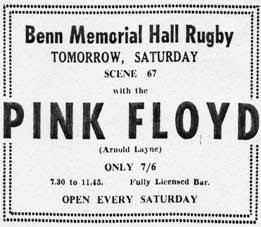
But where, locally, The Pink Floyd did perform with Syd Barrett at the helm was at the Locarno during May 1967 and the Benn Hall Rugby during April of the same year. These gigs were either side of one of the earliest significant events The Pink Floyd played at. And that was the 14 Hour Technicolour Dream event at the Alexandra Palace on April 29th. Apparently the Floyd made it to the stage at around 5am, having driven back from an earlier gig in Holland. The event itself was an all night ritual where the Queen and Prime Minister had been offered free tickets. Every one else being charged a pound note.

It is almost impossible to know the actual set lists played at both the Locarno and the Benn Hall but The Pink Floyd would more than likely have included tunes such as Pow R. Toc H., Astronomy Domine, Scream Thy Last Scream, Interstellar Overdrive, Candy and a Currant Bun (AKA Let's Roll Another One) and Arnold Layne which had not long been released as the bands first single. And, only based on reading different books, the gigs may possibly have begun with Reaction in G but I am far from certain about that.

Hard to imagine now but when bands like The Pink Floyd and Soft Machine began to take off, the fans of that kind of music were, initially, given a hard time. Both bands attracted the more 'way out' youth. The 14 hour event was described by organisers as 'a calculated attempt to try to avoid the kind of discipline and squareness that their parents own lives represented'.

Others, who turned up for the event, saw it differently. Some attendees described the more 'turned on' as 'bloody mad, chucking flowers about, what's that all about? They are all mad. We turned up to enjoy ourselves and have laugh and a drink. A lot in there need a bloody good bath'. And there was an element of truth in that. A lot of youngsters, at that time, did grow their hair long and had little to no interest in fashion.

A few days after the Coventry gig The Pink Floyd performed their first conceptional concert, named 'Games For May - Space Age Relaxation For The Climax Of Spring' at the Queen Elizabeth Hall in London on 12th May 1967.

During July 1967 when the Pink Floyd's debut album, 'The Piper at the Gates of Dawn' was being released to the music press, the band were accused of being dishonest.

The following question arose: Are The Pink Floyd being quite honest when they make coy and attractive records like 'See Emily Play' then proceed to make the night hideous with a thunderous, incomprehensible, screaming sonic torture?

The bands response was: The Floyd do not wish to appear dishonest, but they are worried. They appreciate the contrast between their records and their live performances and agree the latter might not be all that they should be, and are taking steps to rectify the situation.

This is the point, says Roger Waters, 'we don't think so'. 'We still do Arnold Layne and struggle through Emily occasionally. We don't think its dishonest because we cant play live what we play on record. Can you imagine somebody trying to play 'A Day in the Life'?. Yet that's one of the greatest tracks ever made. A lot of stuff on our LP is completely impossible to do live'.

The early Pink Floyd were not for everybody but there is no doubting that their unique approach to music and live performance certainly had a lasting effect on shaping popular music to come.


Sunday, April 25, 2021

Kraftwerk in Coventry and Birmingham

 Kraftwerk in Coventry and Birmingham.

by Pete Clemons


A few years ago I noticed that German rock band, Kraftwerk, were appearing at Symphony Hall Birmingham. Having never seen them play live since 1976 I really fancied it until, that was, when I enquired about tickets. Not only did I discover that the event had sold out, I also found out that the ticket prices had been an extortionate price. Which all kind of surprised me as I hadn't realised that they were so popular. And yes, I admit, the fact I hadn't really taken much notice of them for over 40 years meant I was completely out of touch.

But when I did think it through maybe I should not have been surprised by their popularity. After all back in the early 1980s Kraftwerk had been a major influence on the new romantic scene that burst out of London clubs such as Billy's and Blitz.

Technologically, I am certain that Kraftwerk would have moved on from when I had last paid any real notice of them. After all, they were never the kind of band to sit on one idea for too long.

Even during the mid 1970s, apart from a keyboard, Kraftwerk had removed the last recognisable instrument from when they began several years earlier. That instrument had been a violin and they replaced it with synthetic drums.

Each drum disc gave a different sound, such as bongo's and snares, by completing the contact with the spring steel batons they held. The hope then was to get rid of keyboards and create jackets with lapels that could be played by touch.

When Kraftwerk released their forth album, Autobahn, during late 1974 the band themselves called it 'Machine Music'. The sounds were created in a studio in Dusseldorf, programmed then recreated on stage with the minimum of fuss. Autobahn was based on the rhythm of cars, trucks and bridges all heard while driving through Germany.

Autobahn's title track took up one side of an LP and lasted for just over 22 minutes. A 3 minute 5 second edited version was released as a single in the UK during 1975 and proved to be an unexpected hit for the band. Just failing to crack the top 10.

And during 1975 Kraftwerk completed a UK tour appearing at the nearby Birmingham Town Hall. For that tour the band introduced new recruit Karl Bartos. Until then, and up till the recording of the Autobahn album, the band had been Ralf Hutter, Florian Schneider, Wolfgang Flur and violinist Klaus Roeder who was with Kraftwerk during 1974. long enough though to work on the Autobahn album but had left before its release. In fact, for the bands earlier releases, Kraftwerk were, ostensibly, just Ralf and Florian.

For that Birmingham concert the bands first three albums were represented by way of performing Kling Klang, Ruckzuck and Tanzmusik. But of course their latest release was being promoted and music such as Kometenmelodie 1 and 2 and of course Autobahn featured heavily.

And it was the quartet of Hutter, Schneider, Flur and Bartos that went on to record the follow up album Radio-Activity as well as returning to the UK during 1976 to tour the album. It was the Radio-Activity album released during 1975 which apparently influenced David Bowie for his Station to Station album.

This time Coventry was a part of the tour and the band visited the 'Lanch' during October 1976. Kometenmelodie and Autobahn remained in the set but new music such as Radioactivity, Airwaves, The Voice of Energy and Ohm Sweet Ohm were also on offer.

After Autobahn, Kraftwerk never really bothered the UK charts again. Until, that was, around the time of new millennium. But that never seemed to stop their popularity and cult rising it seems.


The Model

Radioactivity

Robots

Autobahn


Christopher Sidwell 2021

 Christopher Sidwell 2021

by Pete Clemons


There's a belief in our society that bad things always happen in three's. From natural disasters to household mishaps, if it's happened twice, it's definitely going to happen a third time. Particularly when it comes to death.

The source of the superstition appears to be that if three soldiers lit their cigarettes from the same match, one of the three would be killed or that the man who was third on the match would be shot. Since then, it has been considered bad luck for three people to share a light from the same match. Maybe best to give up smoking altogether.

But it doesn't have to be that way. Because in this case its all good news. And all three occurrences involve local artist and musician Christopher Sidwell.

Specialist record company Ace Records, who excel in re-issues, have been in touch with Christopher. It appears that they are interested in a track he wrote for a previous band from forty years ago, The Digital Dinosaurs called 'The Sideways Man'.

They want to include the track on a new compilation album called 'Winter of Discontent' compilation which the St. Etienne guys are putting together for release in the autumn. St. Etienne's Bob Stanley is a consultant for Ace, along with other record companies. Together with other band members they compile collections of obscure songs. St. Etienne fans are already aware of this and hugely appreciate Bob's discerning musical taste.

The album also includes bands such as Scritti Pollitti, The Television Personalities, The Raincoats, The Melons, Danny and the Dressmakers, The Homosexuals. Also included on the album is another track with a Coventry connection. 'The Window's Broken' by Human Cabbages, a tune recorded in 1980 from the Boys And Girls Come Out To Play EP also finds itself being given a fresh lease of life.

Say's Christopher 'They have sent a contract and are paying me ! The album comes out on CD and vinyl - very excited ! It is not my best material but it was as good as I could do at the time'.

The second piece of good news involves a series of programs documenting what people did during the Lockdown last year. Tentatively titled 'The Lockdown Diaries' the associated stories were built up during 2020 as Christopher completed, and posted up songs, from his Hoi Polloi album with notes about the songs. This formed the basis of a submission Christopher has made to a national radio station. Along with four songs being changed for ones he wrote and recorded at home last year.

Graham Fellows aka Jilted John / John Shuttleworth, and no stranger to Coventry following work at the Belgrade Theatre with Bob Eaton, is mentioned in one of those songs. We both wrote a song using the lines, 'I remember that you came in the period that remained after Christmas but before the new year in the days that have no name'. The project with Graham is completely different - it is a song we wrote a while back together which was called 'Love in the Afternoon' originally. It is now being used in Graham's new film titled 'Father Earth'.

The final piece of news involves a tune Christopher wrote for the Trees, 'Here Come the Trees' album. A version also exists on the Hoi Polloi album by Crokodile Tears. Says Christopher: 'The song was originally titled, 'Save that tree (Melanie)' and is a song about my wonderful friend Melanie Moon. Melanie is trying with others to prevent the HS2 devastation of ancient woodland in Warwickshire. She has the courage to stand up to a project that I and many other of the 'Hoi Polloi' believe to be wrong'. The song, it seems is becoming an anthem with the environmentalists who are against HS2.

Good luck goes to Christopher in his ventures. Maybe the biblical quote that begins with 'For everything there is a season' is a more appropriate for his recent turn of events. A time to plant and a time to harvest.


The Sideways Man - Digital Dinosaurs

Huh - Digital Dinosaurs


Sunday, April 11, 2021

Tom Long and Tony Clarke's memories of Pinkerton's Assorted Colours

 Tom Long and Tony Clarke's memories of Pinkerton's Assorted Colours.

by Pete Clemons


Its always good to hear back on anything I write. It is especially good to hear from someone who personally knew, or had dealings with, the band or whoever I was writing about. So to receive feedback from Tom Long was especially pleasing.

It came after a recent thing I put together about record producer Tony Clarke. Tom was the guitar player for 1960s band, Pinkerton's Assorted Colours, who had hits in the 1960s with 'Mirror Mirror' and 'Magic Rockin' Horse'. And, of course, Tony produced those records. I also remember Tom from my days at GEC where Tom had much knowledge, and awareness, in the early days of home computers.

Tom mentioned: 'I just recently found the piece you wrote about Tony Clarke. Nice piece, he was a good and very talented guy. A few comments to add. The first and only time I recall seeing him playing was at the Rugby Granada with Buddy Britten and the Regents. He left for Decca Records quite early. I didn't know that 'Mirror Mirror' was his first single though I knew he hadn't been doing A&R long and was desperately keen to succeed'.

'Tony had done a wide range of odd jobs. He was proud of the fact that when they sent the Elvis masters over to the UK in mono, they created a second backing track to make them stereo and he played bass. He had met and worked with many greats even in that short time. He was competitive and very keen to compete with his main rival Gus Dudgeon'.

'And then I remember Tony playing us a number he wrote, called 'Five in the Morning'. I don't know if it ever got recorded though'.

'He most definitely added a lot of input to the 'Moodies'. Their records were full of his 'isms'. 'There you go man' was one of Tony's stock phrases, and, spoken on the record, exactly as he often did. I can also guarantee that there was a lot of laughter when Tony completed it with 'Face the trials of piles with smiles!'. Again, I know he would have said that, that was also his stamp'.

'But Tony had another side. He could be a bit sarcastic at times. That said full marks to Reg Calvert that he recognised Tony's abilities and gave him the chance'.

'The stock studio engineer, at Decca Records, at the start was Terry Johnson. He epitomised the old saying, What's the difference between God and a sound engineer? - God doesn't think he's a sound engineer. Terry commanded respect and was a bit of a prima dona. He also enjoyed a drink and I think it possibly led to his demise'.

'Recording engineer, Derek Varnals, was chief lackey cum probationary sound engineer. He did the odd 'B' side for us but he was good. He too, was keen to get on, but did it quietly and diligently. I am not at all surprised that Tony Clarke used him over Terry Johnson. Wise choice. Terry, if nothing else, would have taken twice the studio hours. That is, if he got it to sound as good anyway. Possibly not'.

'Tony Clarke's big nemesis was, of course, Dick Rowe who was still very staid and had learned nothing from having turned down The Beatles. Tony has mentioned that when they had finished 'Nights in White Satin' he was walking on air. He played it to Dick Rowe and Dick just didn't get it. I'm sure Tony was laughing his socks off inside. This was the turning point which got him away from the clutches of Dick Rowe. I'm sure he was on cloud 9'.

'I watched a YouTube video of the 'Moodies' at the Albert Hall. The orchestra were out of this world and their music really lends itself to that treatment, I'm sure the band seriously enjoyed that gig. The conductor looked extremely happy. I just wish Tony Clarke could have been there. Happy memories of Tony!'

My thanks to Tom Long for sharing his thoughts and memories.


Johnny Goodison and The Quotations - March 1966

 Johnny Goodison and The Quotations - March 1966.

by Pete Clemons


Strange how an article I put together a few weeks ago, about Big John's Rock 'n' Roll Circus, led to a chat that gave me enough information to put a few more words together another about the subject matter.

It seems that Johnny Goodison left his home town of Coventry, during mid 1964, in the hope of finding fame and fortune in the great city of London. John Goodison?. To help you a bit he used the somewhat more compelling name on stage, that of Johnny B Great. In London John became leader of a band called The Quotations. And, while in The Quotations, he was the front man of The Walker Brothers backing group.

In a short space of time John had progressed from organist and vocalist to the groups leader, arranger, organist and vocalist. It took a great deal of talent but, by all accounts, Johnny had the lot.

Sound wise it was said that The Quotations had probably the best line up, for that type of vocal group in the country, at that time. During 1966 they were an eight piece, organ, drums, guitar, bass, tenor sax, baritone sax, trumpet and trombone, and Johnny had hopes that the group might be even go on to bigger things. Which of course they did.

Johnny Goodison was interviewed on the opening night of the Roy Orbison / Walker Brothers tour of the UK which began during March 1966. And I found his views very interesting.

'We have completely different acts for ballrooms and clubs' he said. 'Six members of the group can sing, so we use a great deal of vocal harmony stuff for the clubs, and keep the more commercial hits for ballrooms. Obviously we owe a lot to the Walkers but we weren't doing too badly before they came along. There was plenty of work in the clubs and occasional gig with people like The Drifters. It was in one of the clubs that the Walkers first saw us'.

'None of the original Quotations are left now, but our sound seems to be improving all the time. This could be why we haven't had a record released until now but, personally, I think its because I freeze every time I get into a recording studio. I don't know why this is, but I've only just got over it. Anyway our first disc is out now titled 'Going Where the Loving Is', and was A&R'd by Scott Engel and John Stewart his business partner'.

On their current tour The Quotations have added strings for backing The Walkers but say this wont be a permanent arrangement. In their own act they perform such items as 'Don't Fight It', 'I Got You', and a very jazz flavoured 'Summertime' which features fantastic solo's from the baritone of Barry Martin and the trumpet of Tony Allen.

Don't The Quotations feel that they will always be in the shadow of the Walker Brothers?. Says Johnny 'The Walkers sing the type of material that we like, and lets face it, the money's much better, so we've got no complaints. If the Walkers go back to the States for six months we'll go out on our own and see what happens then. The main thing is, we're happy'.


The Quotations continued to tour with The Walker Brothers for several years acting as their backing band for many of their live performances. The group also backed Carl Perkins in 1964 and, later in the 1960s, supported Cat Stevens and several others.

...........
Other articles by Pete Clemons on Johnny Goodison or Johnny B Great.

1 Big John's Rock n n Roll Circus


"The Quotations toured along with The Walker Brothers during 1965/66 and also acted as their backing band for many of their live performances. The Quotations also backed Carl Perkins in 1964 and supported Cat Stevens. Later, when Gary Leeds aka Gary Walker released his single "You Don't Love Me' in 1966 it was The Quotations who were the backing band. Two members of this line-up went on to much bigger things; John Goodison and Johnny Gustafson.
Members: Johnny Goodison on keyboards, Pete ‘Greg’ McGregor and Barry Martin on sax, Graham Alexander on bass guitar, Tony Mabbett on trumpet, Graham Dee on guitar and Jimmy Buchard on drums." https://www.discogs.com/artist/3057121-The-Quotations-3

I Need You - The Walker Brothers with the Quotations