Wednesday, July 13, 2016

Celebrating 50 years of The Moody Blues

Celebrating 50 years of The Moody Blues


Pete Clemons recalls the formation of the classic West Midlands band


Incredibly 2016 marks 50 years since Justin Hayward and John Lodge joined up with The Moody Blues.

The band would then transform itself from, what was already a very good R ‘n’ B group, into a band that would shape and influence the future of rock music forever.

The version of the band to include Justin Hayward and John Lodge first came together during late 1966.

Legend has it that guitarist Justin was actually answering an advert placed in Melody Maker by Eric Burdon of The Animals. Burdon then passed Justin’s details onto the Moody Blues flautist Ray Thomas.

John Lodge was already known to the group having been band mates of Ray Thomas and keyboard player Mike Pinder in the early 1960s Birmingham beat group El Riot and the Rebels.

Drummer Graeme Edge, formerly of Gerry Levene and the Avengers, is now the only remaining original member of The Moody Blues, from their early R‘n’B days who is still performing with the band.

Justin Hayward of the Moody Blues.


The Moody Blues have already completed an American tour this year to mark this momentous achievement. And, throughout the rest of 2016, various other events featuring the pair at their own gigs will ensure that this celebration of their achievements continues.

The first single to include Hayward and Lodge was titled ‘Fly Me High’ and was released during May 1967 and in a recent Moody Blues press release the band recall those early days:

“And one of the first things we did together that year (1967) was record ‘Fly Me High’ at our own expense at Regent Sound Studios in Denmark Street. The suits at Decca liked it but thought it could be recorded better. So we turned up at the Decca studios on the appointed day where we met Tony Clarke for the first time. He was assigned to us as in-house producer and we recorded the song again. Decca released the new version and it was picked up by the BBC who used it as a jingle for a while. It was all absolutely great and ‘Fly Me High’ was the start of our new sound and direction. The Decca engineer on ‘Fly Me High’ was Gus Dudgeon who went on to produce mega-hits for Elton John. He did a great job!”


At the time Tony Clarke was a junior producer with Decca Records who had been assigned to the Moody Blues to produce the demonstration record. Unknown to the record company the Moody Blues gave Tony an insight as to the ambitious direction that they wanted to go. Tony bought into it all and to all intents and purposes went against his masters and aborted the task in hand. Instead Tony and the band recorded what became known as ‘Days of Future Passed’. The record was also released November 1967 on Decca’s subsidiary label Deram.

It needs to be mentioned however that the albums engineer, Derek Varnals, take of the story is slightly different. Derek who, at the time, kept diaries mentions "At some point, Decca decided to liven up the label by having a pop group record with an orchestra,” The Moody Blues project was simply described to me as an album with recurring themes, and for the orchestration they'd be using Peter Knight.

Coventry born Tony Clarke had incredible vision when it came to recording processes and would eventually become known as the sixth Moody Blue, so much so that some albums carried a photo of him.


‘Days of Future Past’ was indeed a whole group effort with each band member contributing. And, arguably, it was this album that brought the Mellotron (an electro mechanical tape relay keyboard) to the world’s attention. Mike Pinder, who played this particular instrument on the album, once worked for the manufacturer of the Mellotron - Streetly Electronics in Birmingham – and has long been associated with the instrument ever since.

The music that followed, six breathtaking and ground breaking albums between 1968 and 1972, stunned the music world with their endeavor and dynamics. They were orchestral landscapes.

The lyrics were a mix of easy going, love and just general thoughtfulness. But most of all they were incredibly thought provoking as they posed questions on the subject of our very existence, they made us examine our own consciousness, and to think of our place within the great scheme of things. This was indeed cutting edge stuff. And, for me at least, those records still thrill after all this time.


Following the album ‘Seventh Sojourn’ the band just had to take a break. Continuous recording followed by extensive touring had taken its toll. According to one band member, they had been living in each other’s pockets for too long. A period of calm followed for the band and a selection of live, compilation and solo albums followed.

Then, after a five year hiatus the band reformed in 1978. Despite the musical climate at that time the resulting album ‘Octave’ received the warmest of receptions. It was as if the whole music world was just so pleased to see the return of The Moody Blues. Again, each of the band members contributed to the song writing. Sadly though, and due to personal reasons, this was to be Mike Pinder’s swansong album. ‘Octave’ was also Tony Clarke’s final involvement with the band. Maybe the album sleeve, where the band is pictured disappearing through a door, was prophetic.

Despite these setbacks the band readjusted accordingly and produced another decent, if not prolific, series of albums. These were particularly successful in Canada and America. In fact The Moody Blues were so popular over in the North Americas that, amongst the many tours, they performed at the Red Rocks Amphitheatre complete with a full orchestra.


The Moody Blues then had another hurdle to clear when founder member Ray Thomas retired from the band toward the end of 2002. Ray has great website full of archive photos. He also gives some heartfelt advice to those of a certain age.

Some years ago The Moody Blues released an album called ‘Sur La Mer’. Well even that has become a reality as the band, for the last few years, have organised a music cruise.

More recently Mike Pinder released a filmed interview that, amongst other things, gave an insight into the reasons as to why he left the band. He also gives a poignant recital of Graeme Edge’s ‘Late Lament’ poem.

And now another new dawn beckons by way of solo and intimate performances. As mentioned earlier, there will be plenty of activity in the region over the coming months. I, for one, have recently bought tickets for forthcoming concerts by both Justin Hayward and John Lodge who will be in and around the area during the next month or so.

It is testimony to the enduring quality of their music that The Moody Blues have achieved top 20 album releases over four consecutive decades beginning in the 1960s. Their output seems to transcend so many generations and does not feel that it sits in any particular era. And I am convinced that The Moody Blues will continue to give pleasure to generations to come.

Wednesday, July 6, 2016

Pete Clemons on Pete Waterman's Show, BBC Radio Coventry and Warwickshire.

Pete Clemons recently went over to Pebble Mill, Birmingham to be interviewed for Pete Waterman's new programme 'Back to my Roots' on BBC Radio Coventry and Warwickshire and West Midlands.

This is Pete's interview, talking about bands that played Coventry or local bands.


'Godiva Festival showcases Coventry's wonderful talent'


'Godiva Festival showcases Coventry's wonderful talent'


Pete Clemons on what was memorable to him at the 2016 three-day event


Godiva Festival 2016 at War Memorial Park


Godiva Festival means so many things to so many different people. It is so vast and varied that no one can take it all in.

Yet those who attended will have had a great experience and will have our own special memories of it all.

Pete Clemons, a regular Coventry Telegraph contributor, found the whole event inspiring.

So in no particular order, other than when they appeared, Pete has put together a brief snapshot of what was memorable to him on the first and third days, having been unable to attend on Saturday.

The Ellipsis: The opening act for the whole event on Friday evening. What a task to be given and how well they took it.

Luna Kiss: By the time Luna Kiss appeared on stage the ever growing crowd were soaking wet after a horrible downpour.

However this excellent performance proved to be very popular. At the heart of the set Luna Kiss showcased the title track from their recent EP ‘Gravity’. By the end of their performance the sun had returned and the audience had been well and truly warmed up sufficiently for the headline acts.

Luna Kiss


JLR Brass Band: What an enjoyable way to begin the proceedings for Sunday. In the vast expanse of the ‘This is Coventry’ tent I was pleasantly surprised as to how much I enjoyed hearing tunes by the likes of Queen and Jimmy Webb played in this fashion.

To fill the space between bands we were treated, in the middle of the giant tent, to some performance art. This involved some amazing high wire acrobatics. Initially I thought that the accompanying music had been pre-recorded. I was staggered to notice that the vocals at least were live.

The Moonbears: One of Coventry’s finest and a joy to listen to. They try to make the best pop music they can with what they have. I personally think they undersell themselves. The Moonbears are incredibly skilled at their craft and play complex arrangements with exciting rhythms. Their set included the very popular tune ‘Catnip’, which given the reaction of the audience, was very welcome.

Callum Pickard and the Third Look: Not only has this band grown in size, they are now a six piece, they have grown in reputation. And that reputation has, from all accounts, spread far and wide. And on this evidence it is easy to understand why.

Tunes included ‘Hoard the Pieces’, ‘Driving Through, Empty Skies’ and the wonderful ‘Lonely Boy and Girl’.

Emma McGann: Back to the main stage and despite having heard so much about her, this was my first introduction to Emma.

Her very energetic set really wowed the sun drenched crowd. And her equally effervescent backing band was also hugely impressive.


Cliff Hands and his Band: Coventry’s very own super group. These are not my words, but those of other people far more knowing than I am. What a great year it has been so far for Cliff, culminated by this gig on the main stage. The set began with the very powerful and guitar driven ‘Going Down’ continued with ‘Liberty Ward’ and the band concluded with a tribute to David Bowie by way of a unique version of ‘Heroes’. This was great touch indeed, greatly appreciated by the by now visibly growing main stage crowd. You really must check out his recent CD release ‘Two Inches Down to Dust’.

Joe O’Donnell’s Shkayla: Joe and his band are perennial visitors to the festival. This year we were treated to the full five piece band and, wow, did they put a shift in. The tunes are fast and furious and a lot of the song titles are in Gaelic which I will not even attempt to name. And it is such a joy to see Joe and guitarist Si Hayden exchanging licks. But the band always throws in a ballad. And they did just that with ‘O’Neill’s Lament’. A beautiful tune that is simply sublime. Surly Joe and the band are overdue a shot on the main stage.

Pete says: "The thing about all the bands and artists I have mentioned above is that, in the main, music is not their full time career.

"What makes it all the more remarkable to me is that music is a passion that they fulfil in their spare time.

"And the music they are creating is their own. It is what burns inside them. Most weekends they can be found playing the pubs and clubs in the region. So please continue to give them your invaluable support."


Pete continues: "Godiva Festival is without doubt the jewel in the council’s crown. It is a showcase for much of the city’s wonderful talent.

"And it is quite possibly the biggest stage they appear on. And this may even lead to greater things for them.

"With almost 15,000 people attending over the course of the weekend, long may it continue to grow."


Monday, July 4, 2016

Pete Clemons talking on BBC Radio Coventry and Warwickshire 2015

Pete Clemons on the Radio 2015 talking about Coventry music.


Vince of Vince Martin and the Vampires on the Radio

The first broadcast from 2015 on BBC Radio Coventry and warwickshire. Vince talks about his memories of playing in Coventry's first Rock n Roll band and his role in Friars Promotions that put some many bands, artists and discos into Coventry's M & B pubs.


And Vince on the Pete Waterman Show 2016


Wednesday, June 29, 2016

Why a Lower Holyhead Road building is crucial to Coventry's music heritage

Why a Lower Holyhead Road building is crucial to Coventry's music heritage.


Pete Clemons on how seeds of 2-Tone were planted in the city.


Charlie Anderson, guitarist with The Selector, joined children on a Two-Tone float during Coventry carnival. 14th June 1980


When it comes to historic archive material, relating to important music related events, between the end of the 1960s and up until the mid-1970s, then that collected and preserved by Trev Teasdel is amongst the most impressive.

Amongst other things, Trev had been an active member of the Umbrella Club when it was based in Queen Victoria Road and instigated the creation of the Hobo Workshop. For a short while, during 1974, the workshop was based at the Lower Holyhead Road Youth Centre and, while there, Trev possibly witnessed the early seeds of development of what became the 2-Tone movement.

He was present at many different events within the Hobo Workshop building which, when combined together, would ultimately gravitate towards each other and create the band who would eventually become known as The Selecter.

The Hobo Workshop came about via a link-up between Hobo - Coventry Music and Arts Magazine and the City Centre Project via Coventry City Voluntary Service (CCVS) after an executive meeting of the Coventry Arts Umbrella (known to users as The Umbrella Club or The Brolly) in May 1974 at the premises of CCVS at Tudor House, Spon Street.

‘We wanted to make the Hobo Workshop a place where people could participate in events and not just consume the arts. Jam sessions were part of this and also provide a situation whereby musicians could get to know each other musically with the possibility of new musically collaborations or bands’.

From that perspective, the building situated in Lower Holyhead Road that once hosted various youth related events over the years is indeed very important.

The building itself, according to a Coventry planning document, began life as a Quaker Meeting House around 1896. And as far back as 1965, and possibly before that, it was a youth centre where bands such as The Smokestacks would be welcome to play.

There was a ground floor area complete with concert hall and a high stage that the Belgrade Theatre once used for rehearsals.

Also on the ground floor there was a small room which would be used for a music workshop and also a cloak room. Upstairs there were various rooms, some of which were used on Tuesday evenings, also by Hobo, for alternative film shows or the street theatre group. He is unsure as to what else the other upstairs areas were used for. Finally, and underneath the main hall, there was a basement area, which when Hobo moved in, was already being used by the Afro-Caribbean community for their rehearsals.

This was 1974 and Trev was running Coventry music magazine Hobo. At that time Hobo was looking for a place to put on new bands who were struggling to get gigs. The Local Education Authority ran the building then but Hobo were given use of the Ground Floor theatre on Monday evenings through a guy called Bob Rhodes, a detached youth worker, who along with research worker Kevin Buckley were both with the Coventry Voluntary service council. This was the same organisation that Charley Anderson (future bass player for The Selecter) worked for at the time.

Original Selecter bassist Charley Anderson (left) with drummer Aitch Bembridge


In parallel to his voluntary work Charley Anderson was also a youth worker at the Lower Holyhead Road centre where he and Ray King, of The Ray King Soul Band, set up and offered activities around music. And it was in the basement area that they facilitated and encouraged creative activities. And when Hobo moved into the youth centre during July 1974 Trev clearly remember Charley’s project was already established there.

And there were plenty of musicians in the basement at that time also including Charley Anderson himself, Desmond Brown and drummer Silverton Hutchinson.

July 1974 saw a Hobo arranged gig at the venue by local band Midnight Circus led by Neil O’Connor (Hazel’s brother) on guitar. Trev had also booked guitarist Neol Davies to organise a jam session as part of the night’s entertainment. Trev had noted Neol’s organisational skills from a previous jam session.

The same evening, Charley Anderson and other musicians were, once again, practising down in the cellar. As people were coming in for the Hobo event, Charley Anderson came up from the basement and asked if he could get some cables from behind the stage. Trev, who was on the door at the time, recalls ‘it was an opportunity for me to ask him if the guys downstairs would like to join in for an informal jam session with Neol later on. Charley went down to talk to the guys and returned to say something to the effect that guys were just getting started and didn't feel ready to play in public’. When Neol arrived at the venue, Trev mentioned to him what was happening down stairs. Rather than the promised jam session after the Midnight Circus gig, Neol said ‘leave it to me’ and went down to the basement and apparently spent the evening in the cellar jamming with Charley’s guys. Now whether or not Neol was already aware of these these guys is unclear but it did later turn out that Silverton and Neol both lived in the same street.

From there, and quite often on a Monday evening, Neol could be found at the Lower Holyhead Road youth centre joining in with the Hobo meetings and going into the basement to jam. Neol has since given plenty of insight into who taught him what with regard to playing reggae properly.

2-Tone heroes Neville Staple,Pauline Black,Arthur 'Gaps'Hendrickson, Roddy 'Radiation' Byers.


Soon after came the formation of Charley Anderson’s band ‘Chapter 5’ a Reggae and Soul Band featuring Charley, Neol, Desmond, Silverton, Joy Evering and Arthur ‘Gaps’ Hendrickson.

With Ray King also heavily involved the whole basement project extended to include a sound system, a football team and a netball team all under the collective name of Jah Baddis.

Around November 1974 Hobo had moved out of Lower Holyhead Road and relocated at The Golden Cross. Ray King and Charley managed to get some funding for the cellar and possibly other areas of the building to be decorated.

As time went on a number of other bands were either formed at, or were at least associated with, the Lower Holyhead Road centre. These included Pharaohs Kingdom, Earthbound, Nite Train, Hardtop 22 and Transposed Men. There was a lot of inter-changeability between the members of these bands before the ‘classic’ 2 Tone line ups settled.

So it is true to say that the basement under that building was the place where the seeds of 2Tone were formed and from where history was created.

Thanks to Trev Teasdel for his memories.


Holyhead Youth Centre, Coventry


Analog at the Hobo Workshop Holyhead Youth Centre September 1974
Analog spawned Ens and eventually Two Tone band The Reluctant Stereotypes.


Chapter 5 with Charley Anderson and Neol Davies c 1977

Hard Top 22


Remembering Coventry folk legend Dave Swarbrick

Remembering Coventry folk legend Dave Swarbrick.


Pete Clemons celebrates the genius of Swarbrick's brilliant career

Dave Swarbrick


It was during the late 1960’s when I first began to listen to the kind of ‘alternative’ music that was not readily available via the top 20, Ed ‘Stewpot’ Stewarts Junior Choice or other daytime radio programmes. Amongst the incredible range of excellent bands and different styles of music around at that time I remember being drawn to the likes of The Strawbs, The Pentangle, The Eclection and Fairport Convention. Despite a lot of their songs being based around ballads and tales from the 17th and 18th century, musically, they sounded so new and refreshing. And this was reflected in the many great festivals that existed back then. An electric folk rock would fit in very well amongst the many blues artists and the modern heavyweight rock bands of that time.

Some of the folk rock albums I remember very well from back then, and still listen to with regularity, are ‘Unhalfbricking’, ‘Liege and Lief’ and ‘Full House’ all by Fairport Convention. Nowadays they are regarded as classics and an essential listen for anyone just discovering the genre. Coincidentally these were the first three Fairport albums that involved the considerable talents of Coventry resident, mandolin and fiddle player, Dave Swarbrick.

Some years after I had first come across these albums and had settled into a life of reading album sleeves, music related books and generally becoming more interested in the music I was listening to I began to delve more into the musicians and their past achievements. I clearly remember discovering two facts regarding Dave Swarbrick that grabbed my full attention.


The first of these was, that of the three Fairport albums mentioned above, it was only at the release of ‘Full House’ that Dave became a fully fledged member of the band. Up until then he had been adding his talents to Fairports albums as a session player.

Dave had joined the Ian Campbell Folk Group in 1960 aged 19. He remained with them until 1966 when he then joined forces with Martin Carthy, Dave had already supported Martin on his debut album in 1965 but went on to appear with him on several others. During the 1960’s he also performed on several other landmark folk albums.

Which leads me to the second fact I mentioned regards his career. Up until he had become known for his work with Fairport Convention and previous to ‘Unhalfbricking’, (putting his other session work to one side), he had already been recorded on at least a dozen other LP’s. Seven of those albums had been with the Ian Campbell Folk Group and five with Martin Carthy.


After the ‘Full House’ album Dave was involved in a further eight Fairport Convention albums. One of those that I remember with particular fondness was titled ‘Rising for the Moon’. This album was significant for several reasons. One being that it marked a return to the band for Sandy Denny who had initially joined the band for their second LP release but then left after ‘Liege and Lief’. Another, more insignificant, reason being that I saw the band on the ‘Rising for the Moon’ tour when it reached Coventry Theatre during October 1975.

Fairport Convention split towards the end of the 1970’s and Dave recorded a couple of albums, for the Transatlantic label, under his own name.

His next significant band was Whippersnapper who formed during the mid 1980’s. This band was completed by Chris Leslie, Martin Jenkins and Kevin Dempsey. Martin and Kevin had of course been members of Coventry’s own folk rock band Dando Shaft back in the late 1960’s and early 1970’s. This formidable and popular quartet recorded several albums and appeared at some memorable gigs. Several appearances at the Burnt Post folk club, up on the A45, are remembered fondly.


Dave Swarbrick performing at Moseley Folk Festival in 2009


Since Whippersnapper, Dave has been involved in many projects. These have included the renewing of his partnership with Martin Carthy with whom two further albums were recorded during the early 1990’s.

The latter end of the 1990’s saw Dave’s health suffer seriously. So much so that at one point the Daily Telegraph wrote his obituary. The illness was well publicised illness and his family and musical friends and fans rallied around in support of events such as SwarbAid 1 and 2. One thing that all this made me realise was that the people involved in the folk scene are incredibly dedicated to the genre and remain one of the closest of all the ‘musical families’.

Thankfully Dave recovered sufficiently to, not only record again, but also perform. He began his full comeback in 2006 with a band called Swarb’s Lazarus which saw him team up with Maartin Allcock and Kevin Dempsey. The name of the band being, I guess, a reference to his obituary and to being raised from the dead. He also saw his services being required once more to add his own uniqueness to several albums.


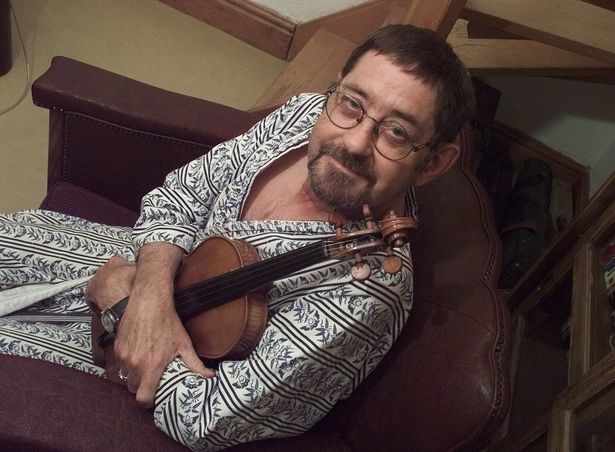
Dave Swarbrick at home in Coventry in 1999


But more recently, and the most significant development, is that Dave Swarbrick and Martin Carthy have re-ignited their partnership. And together, for the last few years, the pair has regularly hit the road for what is fast becoming a customary autumn tour. In fact the 2011 tour celebrated their 70th birthdays. And one of Dave’s final gigs with Martin was at the Warwick Arts Centre during October 2015.

One of Dave’s enduring qualities, I think, was his indifference to awards. It was mentioned by his partner Jill in her touching eulogy that he did not like them and that he was very embarrassed by them. He believed that the music should stand as his testament and legacy.

I have only touched on what I consider to be the highlights of Dave’s career. A full in depth discography, that covers all the album releases Dave has had some sort of involvement with, spans around 100 albums and would be a huge task to document. In my books, though, that is an amazing statistic and an extraordinary achievement and will indeed stand as his legacy.