Wednesday, February 26, 2020

Barnabus


Barnabus
by Pete Clemons


Barnabus, who originally formed in the Leamington Spa area, were and still are: John Storer on a 1969 Gibson SG, vocals, Keith Hancock on a 1963 Hagstrum Corrado bass, vocals and Tony Cox on drums. They came together in 1970 when John and Keith had, not long before, split from covers group The Jay Bee Kay Peys aka The JBKP’s, joined forces with Tony who, himself, had just left his band The Rockin’ Chair Blues Band. Early influences for Barnabus came from the still relatively fledging rock era where bands and artists like Black Sabbath, Ten Years After and Jimi Hendrix were seen to be at the forefront.

The Jay Bee Kay Peys, formed during 1968, had been a popular pop covers band playing the music by the likes of Free, Deep Purple and Led Zeppelin. While active The JBKP’s had in fact gained some valuable studio experience when they entered the Midland Sound Studios at Balsall Common. There, they recorded a pair of original songs in the form of a single. The A side being ‘Look at the Colours’ written by John and his Mother Sylvia c/w an instrumental titled ‘Autumn in Switzerland’ written by John and another JBKP member Bob Chimes. A handful of copies were pressed to sell locally but did not gain general release.

The Rockin’ Chair Blues Band who last performed during the late 1960’s, had been another hard working group. They were regularly seen at venues such as the Drumbeat Club at the Globe Hotel in Warwick. And one of the bands standout gigs was the 1969 weekend music marathon staged at the Umbrella Club in Queen Victoria Road, Coventry alongside other bands such as The Chris Jones Aggression, Wandering John, Dando Shaft and many other leading Coventry and Warwickshire based groups.

Tony Cox takes up the story ‘I was aware of the Jay Bee Kay Peys, John and Keith’s old band, from the Leamington circuit but we had never actually met. Obviously they were aware of me too because when the RCBB folded they approached me and suggested we get together. We started playing rock covers but that soon progressed to us writing our own stuff. At this time I was playing a nice Premier kit, which Steve Broughton had helped me select’. Being friends of Broughton’s and Vic Unitt the RCBB dropped in at their flat in London from where Tony and Steve drove to a local music shop.

The Rockin’ Chair Blues Band line up was completed by Martin Johnson on bass, lead guitarist Stuart ‘Digger’ Davies and Jim Gault on rhythm guitar and they played a mix original material and covers by the likes of Muddy Waters and Howlin’ Wolf.

Barnabus’s debut gig was at Chipping Norton Town Hall on 26th June 1970. This was the first of, what eventually total, an impressive hundred or so dates for the band. But no sooner had they began gigging than there began to be some confusion over their name.

It seemed as though the bands booking agents, for whatever reason, tried to get the band to change their name to Barnabas Legge and began heavily promoting them as such. The newspaper advertising, in the local press, of the band at that time certainly substantiates that claim.

But despite this muddle the band members insisted they remained as Barnabus. Tony Cox clears up some of the confusion: "Barnabas (sic) Legge was the name our booking agents tried to persuade us to use, unsuccessfully!"

However, bass player Keith Hancock remembers it all slightly differently: ‘I was studying at Coventry Technical College at the time and was researching law when I came across a character from Coventry called Barnabus Legge who had been hung for murder in the 18th century. So we named the band Barnabus Legge as it was a sort of macabre name with its sinister background. We dropped the Legge part after about a year when a promoter called Carol Knee(from Friars promotions) made an objection to it...Carol Knee was therefore the person credited as coining the phrase ‘cut the legge off’.

One of the venues that Friars promotions regularly sent Barnabus was to the Walsgrave Pub on the Walsgrave Road in Coventry. These ‘raves at the grave’, to this day, still bring back fond memories to each of the band members. The Walsgrave was also the home to Coventry DJ Pete Waterman who often shared the billing with them.

Barnabus soon began to develop a heavy guitar led rock style that was quite prevalent on the ‘underground scene’ at the time. They also set about writing some very good original material and began to build up a solid repertoire.

And pivotal to all of this was a young lyricist, poet and a good friend of the band named Les Bates. Leamington born Les had once had his work described by local press as being as ‘articulate’ and, ‘being better than a lot of name bands around at the time’. According to John Storer, ‘Les had always been there from the beginning’. And it soon became apparent that we could put our music to Les’s lyrics’. To help broaden their imaginations Les even encouraged the band to attend a performance by poet Roger McGough gig at the, then, recently opened Spa Centre, Leamington.

Armed with sufficient material Barnabus entered the studio during 1971 and recorded their album, the one you are holding now as it happens. The studio was called Monty Bird’s studios, based in Snitterfield near Stratford upon Avon (aka Bird Sound Studios). These studios later became better known locally as Tank Studios. Monty Bird himself was joined in his venture by Bob Young, a local entrepreneur who had formed the Sunshine Music agency based in Gulson Road, Coventry. Bob also ran a folk club/venues and such like. Bob, also from Leamington Spa, along with his brother Colin would also form an outfit named ‘A Band Called George’ (Bell label recording artistes). Tank studios would ultimately run their own independent record label and produced several releases in the mid to late seventies. They handled artists like The Armpit Jug Band, John Golding and Sean Cannon and many others.

The result of the sessions, held between the 6th and 13th November, was that twelve acetates were produced. Originally, the idea was to produce an ambitious double album. The tapes were used to promote the band for a record deal and a few agents for gigs. It was recorded in Mono and on 4 track tape. John recalls that period ‘About a dozen copies were pressed and sold to friends and at gigs for a fiver. There were ten songs on the double album; ‘Winter Lady’ and ‘Mortal Flight’ were not on it as they were recorded later, in stereo. Only two copies of the album had artwork, produced by hand by our roadie Simon Bullpit. He did one for Tony and one for my Mum’.

Consistent throughout the 12 tracks that make up the finished album is clear evidence of a band that have truly bonded. Rather than just being three individuals, they spoke as one. John Storer’s lead guitar playing is dominant throughout. And time and again you are subjected to attention grabbing soloing. Underpinning all of this you have this powerhouse of a rhythm section. This album really does showcase some extremely fine and untapped talent.

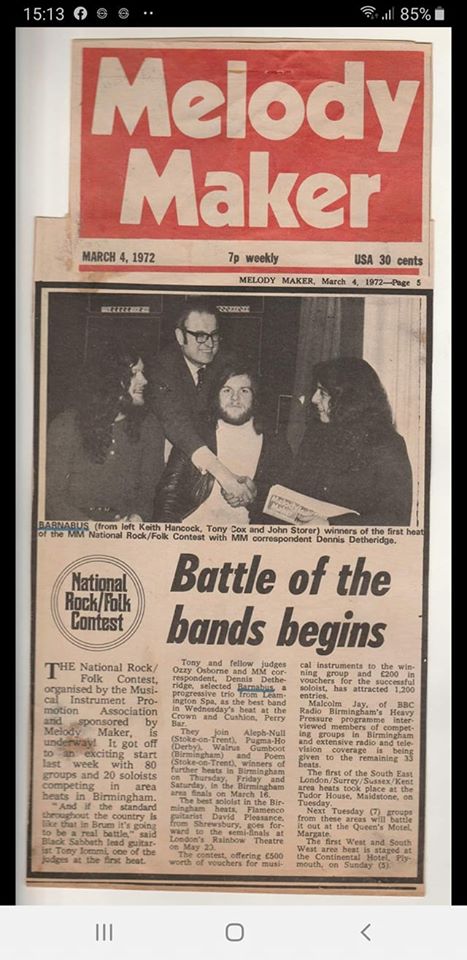
During March 1972, Barnabus gained a major breakthrough by winning the Midlands heat of the Melody Maker Rock & Folk contest. The competition, held at the Crown and Cushion in Perry Barr, Birmingham, was significant because the judges had ben Ozzy Osbourne and Tony Iommi of Black Sabbath fame. After Barnabus had performed ‘Winter Lady’ live both Tony and Ozzie stood up and applauded. They shook hands with the band telling them how great their music was and that their standard was very high.

Both ‘Winter Lady’ and ‘Mortal Flight’ had been adapted from poems written by Les Bates and given to the band after the album had been recorded. The winter lady in question had been about a girl friend of Les’. ‘Mortal Flight’ was written around the idea of Samson and his strength against adversity. A blind man, who was taking on corruption, and had the elements of natural forces behind him. Barnabus decided to combine the two songs, ‘Winter Lady’ and ‘Penny….Come in From the Rain’ to create a kind of rock/folk/myth and regular life fusion.

The next round of the competition was held at Birmingham University but Barnabus failed to progress despite a solid performance. There had been a misinterpretation of the rules and Barnabus lost out on a technicality to a band that had performed a cover version of Black Magic Woman. It was a very good version of Black Magic Woman though. But Barnabus had been under the impression that the competition had been for original music only.

Despite all that, the success at Melody Maker contest enabled Barnabus to further their growing reputation which resulted in them gaining wider recognition and breaking out beyond the confines of Coventry and Warwickshire.

A sudden surge of activity led to several notable support slots for bands such as Man, Trapeze, Van der Graff Generator, Hatfield and the North, Indian Summer and the Edgar Broughton Band at venues like the Chesford Grange near Kenilworth, Warwick University and Henry’s Blues House in Hurst Street, Birmingham.

Birmingham’s Judas Priest even supported Barnabus when Priest was an up and coming band. As Keith reflects ‘Creating music with no boundaries these were, indeed, great days of adventure. And these were, still, the relatively early progressive and heavy rock days’.

Another memorable occasion for Barnabus was at the Plaza Ballroom in Dudley. In attendance was Robert Plant who walked in as they were performing their set that did include ‘Communication Breakdown’ amongst their own songs. The band, along with John’s Mum and Dad, had a really good chat with him at the bar afterwards. John’s Mum was very taken by Robert, initially thinking he was a member of The Move. John’s Mother, however, did leave with a smile on her face after Robert politely kissed the back of her hand before he roared off in his Aston Martin DB5.

Barnabus were even invited down to London where they performed at the Temple Club in Wardour Street taking to the stage, late, at around two or three in the morning. Another London booking, which appears to have turned out to be a real mismatch, was at the Kensington Conservative Club. Keith remembers that they ‘played to a suited up crowd of hooray henry's. There was a portrait of the queen behind us and I cracked a joke about it being the first time I've played in front of her majesty....we went down like a brick budgie!’.

Each of the band members agree, however, that being support band to Hawkwind at the Locarno in Coventry, during April 1972 was probably their most prestigious gig, and, for a variety of reasons. Hawkwind had recently had a van broken into and lost several thousand pounds of equipment. It was a devastating loss that had threatened to finish the band. For the Locarno gig a Hawkwind roadie struck up a deal with Barnabus. If Hawkwind could borrow their Park PA then, in return, Barnabus got to use Hawkwind’s rigging. Spurred on by a partisan home following, Barnabus had to perform as many as three encores. And, as John Storer reflects, it was so thrilling to hear such a large crowd shouting out for tracks to be played such as ‘Winter Lady’.

But Barnabus were still chasing that all important contract. Trying to help things a long John’s father, who also ran the day to day business of the band, sent a copy of their music to the light entertainment department at the BBC. It was acknowledged with a ‘thanks but no thanks, this is not really what we are about’ type of letter.

And then, towards the end of 1972, the trio spent a day in London visiting the offices of Island, Decca and possibly one other record label.

After hearing their tapes the Island label representative told the band bluntly that they were a three piece and this could be clearly heard in their music. And that ‘Not enough was going on within it’.

At Decca it got even worse as officials kept looking at their watches throughout the proceedings. The did mention that they could hear that Barnabus were influenced by Deep Purple in their style of music but if he had the choice to sign either Deep Purple or Barnabus then they would pick the real ones.

Incidentally, when their pressing plant was over capacity, EMI records would ask either Decca or Pye to press albums for them. And this happened to Deep Purple’s Made in Japan release. At around the time when Barnabus approached the label a number of Decca contract pressings of the album were released that famously contained various errors.

The day in the capitol was the final straw. Disillusioned, and with ego’s deflated in a day, the trio headed for home to weigh up their options. Despite being so close to securing a deal, Barnabus decided to split up at the end of 1972. In fact they eventually disbanded after fulfilling their commitments with a final appearance at The Walsgrave Pub in Coventry during January / February 1973.

The passage of time can never erase that fact. Barnabus were certainly on the cusp of something very special. But unlike their contemporaries they just never had that slice of luck or that killer single needed to take them to that next level. Today John and Keith still play regularly together in a new version of the Jay Kay 60s band. While Tony is playing with several local bands. Their love of playing live shows no sign of diminishing. Maybe their time is due now. Who knows?


The War Drags On - Barnabus 1971


Editor's Note -  Their 1971 album is on Rise Above Records who say - 

"Barnabus were a band from the West Midlands/Warwickshire region of the UK, who were active between the years 1970-1973. During that time they built up a local reputation and recorded an album of heavy-duty material in late 1971, which has never seen the light of day until now! 

The CD edition comes with a 44-page booklet detailing the history of the band, including many photos and flyers from their personal archives. The double album comes in gatefold sleeve featuring original 'homemade' artwork for one of the acetates owned by a band member. Truly a cult album for fans of obscure, heavy 70's progressive hard rock!"
ere a band from the West Midlands/Warwickshire region of the UK, who were active between the years 1970-1973. During that time they built up a local reputation and recorded an album of heavy-duty material in late 1971, which has never seen the light of day until now!
Here is an earlier article Pete Clemons wrote on the band for the Coventry Telegraph with photos and youtube
https://coventrygigs.blogspot.com/2013/11/barnabus.html

And a more recent article on one of their charity gigs. 


Dave Clark Five

Dave Clark Five
by Pete Clemons


I wonder if anyone has ever noticed that, unlike many other groups from the 1960s, the music of The Dave Clark Five has not been as freely released over the last four decades. And then, it has only ever been in compilation form.

That is because Dave Clark, himself, owns the entire back catalogue, keeping it under tight control. It took a long time for a collection of their work to be released during the era of the compact disc.

Founded by Dave Clark, the 5-piece consisted of Clark (drums), Mike Smith (vocals, keyboard), Lenny Davidson (guitar), Denny Paxton (saxophone), and Rick Huxley (bass). And 2020 marks 60 years since the band formed. And this has been marked by a release called All the Hits which, incredibly, hit the top ten albums.

I recently came across a fascinating cutting from January 1964 which gives an idea of how successful The Dave Clark Five had been back then. It reads:

The Dave Clark Five, sales of whose exciting record 'Glad All Over' passed the 500,000 mark on Christmas Eve, have an extended player (EP) released this week. There are four swinging party type tracks 'Do You Love Me', 'I Know you', 'Poison Ivy' and 'No time to Lose' which is certain to be a best seller as well.

The second quarter million sales of 'Glad All Over' were notched up in just over a week. Dave heard that it had sold 250,000 copies just in time for his 21st birthday on December 15.

Shortly afterwards Dave signed a £50,000 a year contract with Harold Davison and in March set out on a six week nationwide tour. 'Glad All Over' has now been released in America on the Epic label, but in England Dave and the band are considering material for a follow up single.

'We have several ideas under discussion' he told us. 'Nothing definite has been settled yet, but one thing is certain. It will be different from 'Glad All Over' although we intend to keep the stomping beat'.

The tour mentioned in the article did include Coventry and hit the theatre during April 1964. Held on a Sunday it included The Hollies, The Kinks and The Mojos.

Despite massive sales in the UK, along with their huge popularity, 'Glad All Over' was the bands only number 1 here. Although they did achieve several in the US and Canada where they were also incredibly popular.

I understand that this latest compilation is the first top ten chart placing for the band since 1978 and is available in vinyl also.'It’s a trip for me to go back to vinyl. The 60s revisited. This album covers our hits from around the world on both CD and magical vinyl' says Dave Clark.


Thursday, February 20, 2020

Woodstock Festival 1969

Woodstock Festival 1969

By Pete Clemons


Mention great music festivals of the past and the Woodstock festival would at the forefront of those to be remembered. It is considered to be one of the most memorable of them all. It was a springboard for the career of several bands and artists onto a greater carer path and yet, in hindsight, it was a miracle that the event ever took place at all.

The festival was held over the weekend of 15-18 August 1969 and it is estimated that it attracted around 400,000 people. It ended up being far bigger than ever imagined. And everything that could go wrong did go wrong. It could have been a total disaster and almost was.

John Roberts and Joel Rosenman went into business around 1966 when they set up Mediasound recording studios. Through that studio they met Michael Lang and Arty Kornfelt. The quartet joined forces and, being based in the town, formed the 'Woodstock Record Studio'. The idea being that the Woodstock based studio would be a hub for local artists such as Bob Dylan, Tim Hardin, John Sebastian and many others.

This venture then led to the idea of putting on a big concert for those very same artists and January 1969 saw the seeds planted for such an event.

The proposed site for the event, which was now being muted as an arts festival, was in a nearby town called Wallkill. The festival would include all forms of arts and crafts and, after eventually being signed off by the council work began on a stage, and the site in general, during May 69.

A wish list of bands was penned but that list began to whittle away as first Bob Dylan then The Rolling Stones and finally The Doors all declined to take part.

A further problem came during July 1969 when the number of attendees at the festival would be capped, by the Wallkill council, to just 5000. This was despite knowing that far more than 5000 tickets had already been sold. Rumour has it that local people, not happy about it all, were trying to frustrate proceedings.

It soon became apparent that a new site was urgently required. Max Yasgur, a milk farmer, who believed in personal expression, had been following the story. Max invited the festival team to meet up with him. Max Yasgur took the event organisers to the brow of a field that was at the top of a natural amphitheatre.

It was ideal and the new site at White Lake, Bethel, more than 50 miles from Wallkill, was gratefully accepted. But time was against the organising team. With just over four weeks to go until the festival weekend, and ticket sales suggesting 100,000 sales, they were faced with the huge job of re-building a new stage, fencing off the site, providing power and erect lighting.

Five days before the festival was due to start, and with construction still not complete, festival goers began to turn up in droves. This meant that lots of food stalls had to be thrown together at the last minute in order to feed the throng. With the onset of more revellers, the roads to the festival site began to get clogged up.

This affected the delivery of construction materials. Decisions had to be made quickly and so priority was given for completion of the stage. This took man power from the fencing and other activities.

Chaos quickly rained. A knock on effect led to a situation where revellers who had tickets for the weekend were stuck in traffic along the way, while others, who had simply shown up on spec and were without tickets, were getting in for free.

A decision was announced that the fencing would be abandoned and that the festival would be free. Had sold out signs gone up, then things might have been different. However, the free festival decision led to the event organisers getting financially hurt, very badly indeed.

Friday 15th August: was acoustic day. An estimated 200,000 people were, by now, in attendance. Richie Havens opened the festival simply because he was the first of the artists to arrive at the festival site on time. It was soon to become clear that for the rest of the festival and, due to the severe traffic situation, alternative means to transport the bands and artists would be necessary.

Saturday 16th August: rock n roll day. The crowd had grown by a further 100,000 in anticipation of seeing bands such as Creedence Clearwater Revival, Canned heat, Sly and the Family Stone, Mountain, Grateful Dead, Janice Joplin and, of course, Santana. In addition to the bands having now to be dropped in by helicopter, the national guard was sent in to provide additional food and medical supplies that had been hugely underestimated in terms of requirements. Additionally some of the people of Bethel (not all had been agreeable to the festival), who realised that it could be their offspring at the festival, also arranged to send in extra food and supplies. This seemed to give the festival a second wind as it had been on the verge of collapse.

The second day of the festival had ran late and resumed early Sunday morning 17th August. Max Yasgur came down from his farm to address the crowd. The music resumed with a performance by Joe Cocker and soon after Joe had hit the stage the heavens opened and a torrential storm ensued. This halted the festival for several hours. As soon as the rain diminished the festival continued with performances by Ten Years After, The Band, Blood Sweat and Tears and Crosby Stills Nash and Young amongst others. Incidentally CSN&Y were performing for the very first time.

Again, this time due to the storm, the event ran late into the night. Consequentially it resumed early the next morning. So day four began at around 6am on Monday 18th August although it could be argued that the festival had continued throughout the night. But there was some rest bite. The site was in a horrendous state. It was incredibly muddy and, during the night of Sunday 17th and Monday 18th, a great deal of the attendees had simply given up and left.

Consequentially an awful lot of people missed, firstly, The Paul Butterfield Blues Band, then Sha-Na-Na and finally Jimi Hendrix who wound things up. Apparently one section of the crowd had slept through the first couple of acts and recalled being awoken by Jimi playing the national anthem. By all accounts ‘It was a surreal moment’.

The aftermath of the festival began as a huge clear up was organised by volunteers. They collected tons of discarded bedding and debris that had been left behind.

By way of a lavish double LP release of some of the many musical highlights along with money made from the film rights the Woodstock festival turned a profit over a decade after the event.


Monday, February 10, 2020

Atomic Rooster


Atomic Rooster
By Pete Clemons


I was recently reminded, via a review of the much celebrated Lanchester Arts Festival of 1970, about an appearance made by power trio Atomic Rooster. A brief few words mentioned what a fine band they were. The review went on 'Vincent Crane is an entertaining madman at the organ and Carl Palmer's drumming was magnificent. But they could benefit from less volume'. This would have been before Atomic Rooster became a more well known band thanks to the singles charts.

More recently and Atomic Rooster are back in action. And before you, quite rightly, begin to assume that this is an impossibility and that it must be some kind of tribute band, in my opinion this version of Atomic Rooster is indeed authentic and legitimate.

Most folk, who remember Atomic Rooster, could never forget the bands two stellar singles released during the very early 1970s. 'Devils Answer' and 'Tomorrow Night'. And most of those people will also be aware that the trio of musicians who created those records, keyboard player Vincent Crane, guitarist John Du Cann and drummer Paul Hammond are, sadly, no longer with us.

And as good as that line up was, Atomic Rooster, as a band, were so much more in terms of the music created and the musicians involved with the band.

Atomic Rooster were formed during 1969 by Vincent Crane and Carl Palmer. And by February 1970 the band had released their first album. Soon after that album release Du Cann had joined the band as lead guitarist and vocalist.

By the time the bands next album, the acclaimed 'Death Walks Behind You' had been released during September 1970, Atomic Rooster had taken on the shape of its classic line up of Crane, Du Cann and, Hammond.

The band's third album, 'In Hearing of', has to be one of the strangest releases ever as it essentially involved a couple of versions of Atomic Rooster. The classic line up, and then another that included vocalist Pete French, guitarist Steve Bolton and drummer Ric Parnell (who had appeared briefly in an earlier version of Rooster between Carl Palmer and Paul Hammond) on drums.

During the sessions for 'In Hearing of', Vincent Crane effectively dissolved the classic and reassembled a new version of Atomic Rooster that was required for a forthcoming huge tour. Pete, Steve and Ric played alongside Vincent Crane while touring Italy, then across for a coast to coast tour of the United States.

Pete French's liner notes in a CD re-release of 'In Hearing of' state that when Vincent sacked John Cann, which led to Paul Hammond leaving in sympathy, he also removed many of John's guitar and vocal parts from the album.

Pete had had a call from Robert Masters, Atomic Roosters manager, after Vincent had heard Pete sing for his previous band, Leafhound. Pete went to Trident studios, met up with the band, and no sooner had he seen them both Paul Hammond and John Du Cann simply disappeared.

A few weeks before the tour, which started August and went through to mid October 1971, also drafted in the services of Steve Bolton whose own band had just split up. Steve had answered an advert in the music press. Problem was though, he wasn't a lead guitarist. He always played rhythm. It was a baptism of fire as Steve had to give himself a crash course in playing lead.

Bizarrely, the centre spread of the gatefold sleeve for 'In Hearing of' depicts a line up of the band that never actually recorded together.

And this is how we ended up having, along with other songs, an English version of the single 'Devil's Answer' with John Du Cann handling lead vocals and an American released version of the very same song which Pete French sung lead vocals on.

And how we have today, a version of this wonderful band, still touring under the name Atomic Rooster still thrilling audiences.


Sunday, February 2, 2020

Moonshot

Moonshot
by Pete Clemons


We all have an alter ego in us right, starred in our own fictional band maybe?. OK maybe not.

Purple Haze, my own band, were simultaneously reviving and parodying the music of 1960s/70s UK music scene. We began performing in 1967 at the height of the hippie counterculture and achieved national fame after appearing at the Isle of Wight music festival in 1969.

During the 1970s Purple Haze played at, among other places, the Fillmore East and West opening for such bands as the Grateful Dead, The Mothers of Invention and The Kinks. As Purple Haze grew they began headlining at other venues. Once, one of their opening acts was Bruce Springsteen no less. In 1972 Purple Haze was one of just five acts invited by John Lennon and Yoko Ono to perform with them at their One-to-One benefit concert at Madison Square Garden. Subsequently, the group appeared in the 1978 movie The Last Waltz and then reached, perhaps, the height of its success,with its own syndicated television show that featured guest musicians such as Eric Clapton, David Gilmour and David Bowie.

Billing ourselves as 'from the streets of Coventry' Purple Haze members were frequently outfitted in gold lame or leather jackets and sported long unkempt hairdos.

Later, towards the end of the 1980s, I discovered that 'real musicians' had similar visions albeit far more ambitious than my own. Steven Wilson, for example, had put a band together whose members included Mr. Jelly on bass, Sebastian Tweetle-Blampton the Third on electronics and acoustic guitar, Timothy Tadpole-Jones on percussion, the Expanding Flan on drums and, on lead guitar, The Porcupine Tree. They were always welcomed on stage by master of ceremonies Solomon St Jermaine.

Steven's partner in no-man, Tim Bowness, has also revealed that he too had an alter ego. And he has turned his into the most incredible reality.

Moonshot leader Jeff Harrison has, it seems, always been an inspiration to Tim Bowness. After all they were both born in Warrington it seems, both sharing the same birthday. Moonshot, although described as Crimsonesque, were clearly, also influenced by the likes of Yes and Genesis.

This album is such a clever idea and it has been so well executed. The results are staggering. And Tim Bowness, it seems agrees, after I asked him about his involvement in it all.

'I think they’ve done an excellent job as well' Tim begins.

'The idea is that they’ve performed the songs in the style Moonshot would have played them and within that they’ve also echoed the fictional timeline (so, Stupid Things That Mean The World is deliberately delivered in an early 1980s Prog Pop style and Before That Before in an early 1970s pastoral Folk way)'.

'The band worked from my material and imaginary back catalogue. Beyond that, I had no involvement other than telling them which versions I thought were good and assembling the album order'.

'Outside of being Moonshot, the band operate as an all-era Genesis covers band. The bassist was in my pre-No-Man band Plenty (whose album It Could Be Home, I’m still very fond of). They all liked Lost In The Ghost Light, so it was definitely more labour of love than comedy parody'.

I am sure listeners would have soon cottoned on to what was going on here. There are clues to the authenticity of this band within the lyrics. 'The Great Electric Teenage Dream', for example, contains the line 'Automatic, incomplete, an unknown friend, a tossed-off tweet'.

As a stand alone album, however, this release is a triumph and well worth investigation.


Monday, January 27, 2020

Roddy Byers AKA Roddy Radiation

Roddy Byers AKA Roddy Radiation
by Pete Clemons


A Roddy Byers / Radiation song for the Specials


Look in a dictionary under 'maverick' or 'renegade' and you see those words described as a hard hitting rebel who plays by his own rules. A person of few words who don't take no nonsense off nobody. 

A rather remarkable picture found its way onto the internet recently. It shows a group of David Bowie freaks from around 1974/75. And it was taken in the Rose and Crown on the High Street, Coventry. Next door to Bear Inn. 

From left to right the photo shows, back row: Big Jim / John Wankling / Chris Byers / Rod Byers / John Shipley / Dave Wankling / Kevin Brown. Front row: Steven Connolly AKA Roadent / Paul O’Brien. 

And I kind of felt that the word 'mavericks' or 'renegades' fitted the people in that photograph. And I don't mean that with any disdain either. Far from it. More in admiration. From an early age, these people simply played life by their own rules. 

John Shipley went on to form and play guitar for the Swinging Cats,Dave Wankling went on to become vocalist for Urge while Roddy Byers featured in both the Wild Boys and The Specials. And between them they wrote, or were involved in the writing of several important songs. These included Mantovani, Revolving Boy, Bobby, Rat Race and Hey Little Rich Girl. This is indeed a priceless image and a gathering of wonderful talent. 

Most of the names in the photograph were already known but Roddy Byers kindly added the rest. And in doing so we had a rather interesting chat about that period. 

The conversation kind of started when I mentioned how much I had enjoyed David Bowie's music and lyrics. Particularly, for me, the period from 'Man Who Sold the World' through to 'Diamond Dogs'. Those albums are just so incredible. 

Rod: 'Yep a good time 72 till 76 then Punk happened'. 

Me: 'So this image was taken just prior to Wild Boys being formed maybe'? 

Rod: 'Yes around same time'. 

Me: 'Yet despite all of the good things that happened during the 1970s Coventry, and I guess other places, could be brutal and unforgiving for those who veered off the perceived straight and narrow'. 

Rod: 'Most Blokes thought we were a bunch of Puffs but we had all the best looking girlfriends. I married mine '. 

Me: 'And what you touch on there kind of shows that not all aspects from that period were not great to live through'. 

Rod: 'We got picked on quite a lot There were only certain pubs where it was safe for us to go to'. 

Me: 'I can imagine. I got 'done in' for wearing purple platform shoes once. Could also guess the safe pubs also. But, as far as I am concerned, you all had last laugh' . 

Rod: 'Most of us became punks or new wavers'. 

Just for some clarity, I became aware of punk rock as early as August 1976. October 1976 saw what was considered to be the release of the first punk rock single in the UK. So it you were aware of the onslaught to come before any of those dates, as the guys in that photograph clearly were, then you really were ahead of the rest of us. And not only that, those guys believed in it and realised the impact it would bring. 

Me: 'You were all very switched on and way ahead of the time, I do know that much'. 

Rod: 'Well when I came back from seeing the early punk bands in London not all the Bowie freaks were convinced. Same as when I started looking rockabilly some of my punk friends didn’t like it. Young Americans era that's why I got into punk, I didn't like the soul boy thin white duke stuff much'. 

Again, and for the purpose of clarity, the period Rod was talking about here was the first half of 1976....maybe slightly earlier. 

Me: 'Add me to those not convinced by punk initially. Took me a little while, but got there in the end'. 

Rod: 'Yes it was a revolution of sorts but when the Glam Rock thing started a lot of long haired rock guys felt the same way. I guess every generation had its own anthems'. 

Me: 'I remember being at Knebworth 76 and read about punk in a Sounds mag that was handed to you as you entered the venue. I remember that Pistols/Clash gig at Lanch being advertised. But the lads I knocked around with didn't fancy it. I did see both bands eventually but should have gone with my gut feeling that night'. 

Rod: 'I was at the Lanch but I'd already seen them both at the 100 Club in 1976 The sound was awful you couldn’t hardly hear the words But the attitude and way dressing was wonderful '. 

Me: 'Wow, just the thought of you seeing them in 76 simply blows me away. But twice !!. This was months before they became household names. You and that Scon (Steve Connolly) were way ahead of the curve'. 

Rod: 'Well I'd been listening to the Ramones and The Stooges , New York Dolls etc. so it wasn’t that radically different '. 

Me: 'See I didn't. I was too much into progressive rock I guess. I did catch up with them though. Particularly the Ramones. Was it through Bowie you heard the Ramones etc.'? 

Rod: 'Lou Reed the NYC stuff I suppose. I was into Hendrix & the Cream in my early teens too'. 

Me: 'I enjoyed Hendrix, Cream and Bowie but I didn't get into that NYC stuff. My brother, however, went to see Lou Reed in Birmingham during the early 70s'. 

Rod: 'Velvet Underground all that stuff. My older mates turned me on too a lot of stuff'. 

Me: 'I was too stuck into Yes and Caravan etc.'. 

Rod: 'Not my thing even though I saw Yes. I kinda switched to T. Rex n Bowie and Roxy Music after the rock stuff. But I listened too a lot of black blues as well and early Rock'n'roll '. 

Me: 'Got to say I have really enjoyed this chat. I find it all so interesting how it all developed for you'. 

I then asked Rod if he would mind if I developed our chat into a blog. And in true maverick/renegade style he said........ 

Rod: 'Yep why not nothing I’m ashamed of'. 

For the completion of this article my thanks go to Milan Stojsavljevic and Joe Kerrigan (Horizon photography) and John Shipley for making the photograph available. And, of course, to Roddy Byers for the wonderful chat. 


Lorrain Roddy Byers (Radiation) with his first punk band in Coventry The Wild Boys 

Hey Little Rich Girl Roddy Radiation and the Skabilly Rebels

The Wild Boys - We're only Monsters.

The Wild Boys - We're only Monsters.


Baker Gurvitz Army

Baker Gurvitz Army
by Pete Clemons


Not only did 2019 see the loss of renowned and charismatic drummer, Ginger Baker, it also saw an influx of reissues from a band who are only touched upon when the media focuses on Ginger's life.

Firstly, April saw the release of a box set collecting together remastered editions of the entire studio works from the Baker Gurvitz Army.

Then, during the second half of the year, and, in celebration of Gingers 80th birthday, as well as in remembrance of their manager Bill Fehilly, a previously unreleased live album by the Baker Gurvitz Army was set free.

And all of these albums are really worth investigation. In fact almost any release involving the Gurvitz brothers is worth a listen.

Ginger Baker was famed for being taught 'time' by fellow drummer Phil Seamen during the late 1950s. This led to Ginger having stints with Blues Incorporated, Graham Bond, Cream and Blind Faith.

Ginger also formed Airforce with jazz drummers Phil Seamen and Art Blakey at, it was reported at the time, huge expense. And it was apparently an incident at one of those gigs that set the scene for an ice breaker when he met the Gurvitz brothers several years later at the Speakeasy.

Following Airforce Ginger move to Africa to get into a style of music first introduced to him by Phil Seamen. While there he played and recorded with multi instrumentalist Fela Ransome-Kuti and Africa 70. But after three years in Nigeria, that included the building a recording studio, it all went badly wrong.

Returning to England, Ginger was absolutely broke, and needed to start working again in order to get some much needed money.

And it was at this point that Ginger met with Adrian and Paul Gurvitz at the Speakeasy in London during 1974. They invited him to a rehearsal with them. It was all he could get according to his wife. But it was also around this time that Ginger left his wife for his daughters first boyfriends sister. Married 18 year old Sarah Dixon.

By all accounts the bands manager, Bill Fehilly, was quick to see the potential in the Baker Gurvitz Army and also guided Ginger through a more settled period as he became a good friend and ally. The Baker Gurvitz Army also included Steve Parsons aka Mr Snips on lead vocals and keyboard player Peter Lemer.

Ginger Baker became fitter and healthier during most of his time with BGA. He appeared to have left the hard drugs behind. But that was all to change during the recording of the 'Hearts of Fire' album. 'Hearts of Fire' was the third and final studio album by BGA, released during 1976.

The crux of this set back for Ginger coincided with the loss of his new mentor Bill Felhilly who was killed in a plane crash during July 1976. It was a disasterous period for Ginger who decided to get away from everyone he knew and moved to Italy. During his time there he kept dogs and a couple of horses and lived in, what was described as a 'delapedated house'. Second wife, Sarah, ended up going off with a young local lad.

The Baker Gurvitz Army were no more. But they left us with a wonderful legacy that has, once more, been made available to us.

Incidentally, there is a tenuous link between the Gurvitz brothers and Coventry. Both Paul and Adrian Gurvitz were once members of rock trio, The Gun, who will always be remembered for their hit single 'Race With the Devil'. Coventry musician and songwriter, Johnny Goodison was credited as the producer of The Gun's self titled album from 1968. This was purely by the fact that John had worked for CBS records and had them up the band. That was about all he did by way of production work.