Thursday, September 26, 2013

Roddy Radiation

This time Pete Clemon's has focused on Special's songwriter / guitar player - Roddy Radiation (Roddy Byres) who formed one of the earliest punk bands in 1975 - The Wild Boys, who had two tracks on the 1980 compilation Sent from Coventry and went on (post Specials) to form a string of Rock a Billy bands. Pete's article for the Coventry Telegraph will tell you more.


Rebel man Roddy still riffing

Pete Clemons on Roddy Byers of The Specials, The Bonedigger and The Skabilly Rebels


He has more than a hint of James Dean in his appearance and from what little I know of him personally he is a fairly reserved sort of person.

But as a guitarist, Roddy Byers is far less so. It is on a stage that he really cuts loose. He has a controlled aggression which is, at the same time, incredibly innovative.

Of course as Roddy 'Radiation' he is without doubt better known for his lead guitar and song writing activities within The Specials. But, for me, he saves his best work for the other bands he has fronted since The Specials split back in 1981.

Those bands have included The Tearjerkers, The Bonediggers, The Raiders and, more recently, The Skabilly Rebels. And these groups have provided the vehicle for his love of 1950s rock 'n' roll and rockabilly.

The Tearjerkers were in fact up and running while The Specials were still in existence during 1981 and were an outlet for songs Roddy had originally written for The Specials but had been rejected.

Roddy's music has always had that early Elvis Presley/Gene Vincent feel to them and maybe that style just never suited The Specials.

The Tearjerkers had several lineup changes but at the time of recording they had been made up of Roddy (vocals/guitar), Mark Byers (vocals/guitar), Joe Hughes (vocals/bass), Pete Davies (drums) and a wild accordion player called 'Slim Tearjerker', aka Clive Pain, who also contributed to the vocals.


During 1978 'Slim Tearjerker' had achieved the accolade of being named 'Champion Blockhead' when he was selected by Ian Dury in a New Musical Express competition and befriended the likes of The Clash and The Specials which led to his friendship with Roddy.

As well as playing for The Tearjerkers, Slim also turned out for bands like The Boothill Foot-Tappers, The Rough-House All-Stars and The Skiff Skats. He also wrote what he described as a 'masterpiece of a love song' titled 'You're Too Bloody Good For Me'.

The Tearjerkers recorded for Chiswick records where a couple of songs 'Desire'/'Western Song' were released as a single. Some of their other recorded material can nowadays be found on compilations such as 'The Chiswick Story - Adventures of an Independent Record Label 1975-1982' and 'Don't Let the Hope Close Down', a benefit album for the famous London music pub venue The Hope and Anchor not to be confused with the one that once stood at the ring road end of our own Whitefriars Street.

Locally the band played regularly at venues such as The General Wolfe and The Freemasons Arms and the line-up did change several times during their existence. The Tearjerkers eventually split up in 1987 because there had been no major recording success.

Next up for Roddy were The Bonediggers. Again this band was fluid but during its existence the main musicians behind Roddy included David West (vocals/guitar), Sam Smith (bass), and drummers Gaz Muldoon and Jim Pryal. A great piece called 'Bonediggin' was used as the band's signature tune.

The Bonediggers were regulars at the the Tic Toc club and had their unofficial base at The Dive (Lady Godiva) pub. Demos were recorded at The Depot studios at the rear of the Belgrade theatre.

And, in 1990, a three-track EP released on the Rimshot Record Label featured a track called 'De Angelo' and also included a new version of old favourite 'Desire'.

Roddy left The Bonediggers during September 1993 but soon returned to the action with a group called The Raiders.

At the time Roddy was quoted as saying 'Whereas The Bonediggers was Hank Williams meets The Clash then The Raiders are The Clash meets Hank Williams. A good time rock 'n' roll band with a punk attitude'.

In addition to Roddy on guitar The Raiders were Sam Smith on bass, Gaz Muldoon on drums, Badger on Sax and Ian Toughie on guitar and although short lived they still managed to record a sixtrack tape and fulfilled live dates at venues like Sir Colin Campbell and The General Wolfe.

An excellent 18-track anthology CD was released during 2005 which brings together recordings from the above period in either original form or a re-worked format.

It really is a great release and a lot of these songs are still played live today.

In fact the track 'Lorraine', albeit performed on this CD by The Tearjerkers, originally dates back to Roddy's pre-Specials band The Wild Boys. 'Lorraine' was also one of two contributions from The Wild Boys to the compilation album 'Sent From Coventry' that was released towards the end of the 1970s/early 1980s.

For almost ten years now Roddy has fronted The Skabilly Rebels and they play exactly what the label says. Ska and rockabilly complete with a mix of punk, country and blues.

Backing Roddy over the years of this venture is long time musical partner Sam Smith on guitar, the late Iain Howard also on guitar, Jaynie Jones on keyboards, Mac on bass and Drew Stansall on sax, both Paul Ayriss and Terry Downes on drums and many, many others.

2009 saw The Skabillys release their debut CD, which was recorded at Moonbase Studios in Earlsdon and contains 16 tracks of which some are more up to date workings of songs heard during his years as a Tearjerker/Bonedigger such as 'Black Leather Jacket' and 'Judgement Day'.

February and March 2012 saw Roddy complete a 12-date tour of California, Reno, Nevada, and Phoenix, Arizona over in the USA. Rather than take the normal band Roddy teamed up with American talents such as Danny Dean of Danny Dean and the Homewreckers and billed themselves as the U.S. Skabillys and, between them, played a mix of past and present and new songs from Roddy's songbook.

Roddy is undoubtedly his own man or, for want of a better phrase, a true rebel. He was one of the very first people in Coventry to discover punk rock and regularly visited London during its early days as 'pub rock'.

This was well before that particular genre had left the capital. I am convinced that, some day, history will give him the same 'hall of fame' treatment afforded to other musicians from that era. One that I think he richly deserves.


Monday, September 23, 2013

The Mad Classix (Coventry band in 1960's)

Pete Clemons focuses Coventry 60's band The Mad Classix for his latest Coventry Telegraph article.


Classix line up on TV talent show
By Pete Clemons


FOR those with extended memories you will remember that Opportunity Knocks was a television talent show hosted by Hughie Green that ran from the mid 1950s through till 1978.

The show was revived again in the 1980s by, first, Bob Monkhouse, and then Les Dawson. The winning acts on Opportunity Knocks were decided by way of a public vote. And this was done by completing a post card, in your own handwriting, and posting it off. Quite often the winners would then go on to appear again on the next show.

To give an idea as to how the acts had done the studio audience reaction to each act was measured by a 'clap-o-meter', however this only an indicator and did not count towards the final result.

The programme was normally recorded the Friday before transmission, so votes had to be in by Thursday in order for them to be manually counted before the following day's show where the results were read out. With technology moving on, telephone voting was introduced for the revived series to make that process quicker. So in effect, and as you have probably guessed by now, the whole show was an archaic version of Britain's Got Talent or The X-Factor.

The Mad Classix was another of Coventry's popular beat groups who existed from the early to mid 1960s. And August 1964 saw them appear on Hughie Green's version of Opportunity Knocks. As far as I can ascertain they were the first Coventry group ever to appear on a television programme that was relayed nationwide throughout the country.


The band had been put forward for the show by promoter Vince Martin. And for their appearance the band travelled second class, with Vince, up to Manchester where they stayed overnight. The Classix rehearsed and recorded the performance the day before it went out at ATV studios in the city.

The full line-up of the band at the time of their TV appearance was Ron Smith (lead guitar), John Davies (bass), Dave Norris (rhythm guitar), Brian Fowdrey (tenor sax), Gerry O'Brian (drums) and Johnny Wells (vocals).

The group's manager, Phillip Newton, revealed prior to the showing that the six band members would be appearing on the television each with a silver streak dyed in their hair. The streaks were apparently added by a hairdressing salon in Bell Green and were given the thumbs-up at the make-up department of the TV studios when the band went along there for the screen test.

Apparently this gimmick also proved to be popular with the queues of fans that would form outside the New Inn at Longford at the time as they began to mimic the band who had a regular Thursday night residency at the venue. For the Opportunity Knocks show The Mad Classix performed a song called 'Keep on Looking' which had been written by lead guitarist, Ron Smith and, according to the local press at the time, its release as a single depended on how it was received on the show.

The Classix did not win but performed really well and far from disgraced themselves. They finished a very creditable runner-up to body builder Tony Holland who had been on a roll on the show with several wins under his belt for his routine that included flexing his muscles to the sound of the 'Wheels Cha Cha' music.

However, Hughie Green must have seen something in the band because, during the proceedings, he made them an offer. It was along the lines of, he would make them stars, if they all shaved their heads and re-named themselves The Eggheads.

It was apparently a genuine offer but after some serious consideration the band politely turned the chance down.

The Mad Classix had plenty of history before, and after, the Opportunity Knocks experience though. They first formed during early 1962 and were known as The Tornadoes but after the Joe Meek band of a similar name sold more than five million copies of the track 'Telstar' they had to change name. They then went on the road simply known as The Classics. The earliest example of the word 'Mad' being added to their name, that I can trace, was toward the end of 1963 for a gig at the Coventry Flying Club. 

The first six months of 1964 saw The Mad Classix tour Germany where they teamed up with German band The Rattles who were incredibly popular in their native country as well as gaining chart success here in the UK with a song called 'The Witch'.

Guitarist Dave Norris was not available for this tour so the band had recruited Beverley Jones. Life on the road was uncomfortable, yet enjoyable at the same time, but Beverley yearned for home.

1964 also saw The Classix not only appearing in Coventry but, due to their exposure on TV, also saw them take on a five-date tour of Wales and a nine-date tour of Scotland.

1965 would prove to be just as busy for The Classix. And July of that year saw them expand by adding ex-Chad's band member and sax player, Johnny Williams, to the line-up.

The same year also saw the band go back to Germany for a further tour. It was while there for that particular tour where they eventually recorded a seven-inch single which would be released in December of that year.

The songs included on that single were its A side 'My Hunny Bunny with 'It's Never Too Late' selected for the B side. Both compositions were credited to Brian Fowdrey and released on the Storz record label. As far as I understand this record was only ever released in Germany. However, the advent of the CD has made rare release more accessible. And, as such, 'My Hunny Bunny' can be nowadays be found on two releases 'Tommyknockers Beat Club volume 9 (Reelin and a Rockin till the break of day' and '60er Rare Beat - volume 2'. Ron Smith left in April 1966 and was replaced by Jeff Lynne for a short while and then later in the year and after having all their equipment stolen the band finally split toward the end of 1966.

For more detailed and revealing information on the band, as well as being a tremendous read in general, I can thoroughly recommend bass player, John Davies' recently released book 'The Mad Classix - A History'. It is available to purchase now from the 2 Tone Centre on Ball Hill.
The MAD CLASSIX 
circa 1964-66 
Pete Chambers Godiva Rocked to a Backbeat

R&B/Beat group
Line up: Brian Fowdrey (Saxophone), Ron Smith (lead guitar), Dave Norris (rhythm guitar), Johnny Wells (vocals), John Davies (bass), Gerry O'Brian (drums)

Formed around 1964, they quickly worked up material, switching from 'beat' to more blues influenced material. They cut demos around the middle of 1964 (including 'Keep On Looking'), hoping to impress EMI or Decca. They Appeared on 'Opportunity Knocks' in June of that year and had their hair dyed specially for the appearance with one white streak!

Toured Germany (where they released a single in December 1965) and added Johnny Williams (Sax) from The Chads whilst there in July 1965.

Ron Smith Left in April 1966 and was replaced by Jeff Lynne for a short while. He left the band and joined the Nightriders in Birmingham who became Idle Race - then to the Moveand ELO.

They split later in 1966 after having their gear stolen.

Single: Honey Bunny (Germany 1965)


Photo via Clive Berwick

Pete Chambers - Godiva Rocked to a Backbeat
"Known for the mad stage antics, they played 6 months in Germany and the above single. Bev Jones was once a member and married lead vocalist Johnny Wells. Ron Smith says " I wouldn't have missed the German tour for the world. It was hard for me because I had a wife and family at home. We worked three to four hours a night, six days a week and rehearsed on the 7th. Yes it was hard work but an opportunity I couldn't miss."

And from Pete Chambers Backbeat article - Cov Telegraph
"
Outrageous Mad Classix lived up to their name

FAMED for their on-stage antics and a fabled tour of Germany The Mad Classix were a sextet who always lived up to their name.

In 1958 Ron Smith had purchased his first guitar, and the skiffle sound of that era was now giving way to a more sophisticated music that we know as rock 'n' roll.

Ron, along with his new guitar, had become a founding member of the Coventry band The Tornadoes. By 1962 a name change had become incumbent to them when the great Joe Meek had created Telstar by the band he called The Tornadoes.

So Coventry's Tornadoes became The Classics, and they continued to find work in places like the Wyken Pippin and their sleek presentations and acrobatic stage antics gained them a residency at The Walsgrave.

They hooked up with Friary Promotions and took on sax player Brian Fowdrey who was working at the agency.

By now the band had grown to a …" 


Tom Long added in a comment recently

Hi Trev,

Thought you might like to know this, as a addition to The Mad Classix story.

On Saturday 29/9/2012, Brian Fowdrey, the saxman and founder member of The Classix wed his partner of many years.
The original members of the band got together (minus the singer, who died a while back), and gave a half hour performance.
I had the honour of performing with them, as Gerry, their drummer hadn't played for over 30 years! We persuaded Gerry to play a couple of numbers with them, though.
Ironically, the first gig I did with Jason and the Canaenites was as support for The Classix, at The General Wolfe in Foleshill back in the 60’s!

Cheers, Tom Lane


Mad Classix with Bev Jones. Pic via Pete Chambers Godiva Rocked to a Backbeat


Wednesday, September 11, 2013

The Sabres (Coventry band)

Pete Clemons now looks back at one of the top Coventry bands from the 1960's - The Sabres - for his latest Coventry Telegraph article.

The SABRES
circa 1963 - 1965 Source Broadgate Gnome
Formed 1960 (according to Pete Chambers) and 1963 to Broadgate Gnome!

Beat group

Line up: "Q" Martin Cure (vocals), Steve Jones (guitar), Terry Wyatt (guitar) (From The Zodiacs), Graham Amos (bass),Paul Wilkinson (drums).

Formed in March 1963 for a charity concert in aid of Coventry & Warwickshire Hospital, they were managed by Frank Jones, father of the guitarist. Hard gigging band they took part in the 150th birthday celebrations for Sir Robert Fossett's Circus, including an 8000 mile trip of Eastern Europe !. (they became only the second British group to play behind the Iron Curtain, in Czechoslovakia. (See Martin Cure's comment below).

They also appeared on the BBC's Welsh Programme, Southern and East Anglia TV .

They made demos for Parlophone although they were eventually signed to Philips by bandleader Cyril Stapleton.


From Pete Chambers Godiva Rocked to a Backbeat

" The Sabres became part of Sir Robert Fossett's Circus in 1962 and toured with it for 7 months. We did a 15 minute set to drag the older kids in and it was during the Jelly Baby craze that Ringo of the Beatles had initiated. So kids would throw tons of Jelly Babies at us! Our set was immediately followed by the Elephants and their keeper hated us because the elephants didn;t like walking on Jelly babies and it was hard to get them to perform. It was an interesting 7 months, we learned a lot of things as we were part of the circus we all had to muck in and help put the tents up. Though I don;t think we ever fitted in but it was all good press for us. Martin Cure."

Frank Jones was their manager and father of Guitarist / songwriter Steve Jones. He created some fantastic press stories, much of it unfounded. Like the one about us travelling 8000 miles to tour Eastern Europe and being the second British band to play Czechoslovakia.None of it was true but it was great press and got us noticed!"

Drummer Jim Pryal adds " The Sabres appeared on 'ATV today' and changed their name to 'The Flying Machine' shortly after. Paul Wilkinson, the drummer went to Cardinal Wiseman Secondary Boys school as I did. He was a good drummer. "


........................................

Sept 2013 - Pete Clemons wrote this article for the Coventry Telegraph


Big Top fun for The Sabres.
Pete Clemons 

SEVERAL years before The Rolling Stones had the idea of hiring a big top from Sir Robert Fossett to film their own rock 'n' roll extravaganza, the theme of a beat band touring with a circus had already been achieved by The Sabres, a beat band from Coventry who existed between late 1962 and 1965.

The roots of The Sabres can actually be traced all the way back to about 1960 when Watery Lane resident Frank Jones formed 'Watery Lane Youth Club' in an attempt to stimulate and create activities for son Steve and his friends, rather than see them hang around on street corners.

The club was based in the garage of Frank's house and initially attracted a handful of youngsters who spent two nights a week in a secure environment playing board games and being provided with soft drinks and crisps.

Another function of the Watery Lane Youth Club was to act as a safe haven for any youngsters who for whatever reason had drunk too much and needed a place to sober up before going home to their parents.

In essence, the whole place allowed kids to let off some steam and to generally have a good time.

However, word spread about the club it suddenly found itself attracting youngsters from as far as Keresley Village, the Dales in Holbrooks and even Exhall. So popular it became that some 18 months after the club formed the membership was in excess of 300 and had to be relocated to new premises in New Road just off Bennetts Road.


As a youngster Steve Jones' real passion was in music and in particular rock 'n' roll. And like a lot of teenagers back then in the late 1950s and early 1960s he was eager to own a guitar and form a band. And through the club, that his father had formed, that dream became a reality as Watery Lane Music Group grew from within the youth club with several of its members showing an early interest. As a result, it was that music group which was responsible for the birth of The Sabres.

The initial line-up of The Sabres was Steve Jones (guitar), Kevin Smith (guitar), Graham Amos (bass), Paul Wilkinson (drums) and "Q" Martin Cure (vocals). Terry Wyatt joined the band slightly later when he left The Zodiacs and was a straight replacement for Kevin Smith.

Frank Jones went on to become the band's manager and booking agent and The Sabres soon secured residencies at venues like The General Wolfe and the New Inn at Longford and built up a considerable following. And during August 1963 they headlined a gig in the Lower Precinct which, due to a huge downpour, was dubbed as 'Rockin' in the Rain'. Despite the horrible conditions the crowd that gathered was tremendous.

Apart from gigs gained in Coventry The Sabres were now securing work in places like Morecombe, Skegness, Mablethorpe, Stoke-on-Trent, the 2I's coffee bar in London and on the Isle of Sheppey in Kent.

Steve Jones recalls the Isle of Sheppey gig well as it seemed as though the whole of the youth club had followed the band down there in a convoy from Coventry. And don't forget these journeys would take six or seven hours to complete as these were the days of the trunk road and long before the M1 and other motorway routes had been completed.

January 1964 even saw The Sabres perform at a special 'Coventry Sound' concert held at Coventry Theatre. Although headlined by Brian Poole they featured alongside the likes of The Mighty Avengers, The Mustangs, The Matadors and several other top Coventry bands.

TV work also came the band's way as they appeared on a programme called 'For Teenagers Only' recorded at the Birmingham TV studios.

April 1964 then saw The Sabres embark on the circus tour that kept them on the road for seven continuous months. The tour came about from responding to an advert in 'The Stage' magazine.

Sir Robert Fossett's circus had clocked up 150 years that particular year and to help celebrate the occasion a special tour had been devised. And this particular tour required a beat band to open for the main event and to entertain the teenagers.

The Sabres were judged to have been the best of the 33 bands that had applied for the position by the general manager of the circus Harry Allison. As the band was considered a part of the circus they were also expected to muck in and help put the tents up and muck out the elephants and lions.

The circus began in Wales and toured the whole country from April through to the end of October 1964. The deal was that The Sabres would complete a 15-minute set but as the tour progressed and the band's popularity increased, their performances would run for much longer and in front of audiences of upwards of 3,500.

During its travels the circus picked up considerable TV coverage.

And The Sabres appeared on the BBC's Welsh Programmes well as Southern and East Anglian TV.

The Sabres already had an established fan club prior to the circus tour. It was run by a fan in St Giles Road, Exhall but as the tour progressed so did the membership as it was inundated with letters. At its height the fan club rose to over 4,000 members. Steve Jones' mother also proudly kept a scrapbook packed with clippings and photos of her son's activities.

Such was the success of the tour and the publicity that surrounded it meant that, when they returned home, the band received an official welcome by the then Lord Mayor, Tom Whiteman on November 2, 1964. The Sabres had been advised not to take their instruments as the council house parlours were not big enough. But this advice fell on deaf ears as Graham Amos took his bass guitar along and the Lord Mayor was photographed with it.

Circus manager Harry Allison also confirmed that The Sabres had had a fantastic reception up and down the country and, in an attempt to bolster his and the band's reputation, made up some amazing stories. One in particular was about them travelling 8,000 miles to tour Eastern Europe and being the second British band to play Czechoslovakia which was then behind the iron curtain. Of course none of the stories was true but it made for great publicity.

After the circus tour, the bookings didn't dry up entirely, but the work was not there as it had been beforehand. They did get some gigs at the Boston Hippodrome in the run up to Christmas '64 and there had been talk of a tour to Germany which never materialised. 1965 saw The Sabres back at the New Inn and the Heath Hotel. They had also gained summer season bookings in Morecambe, Lancashire.

However, mid-1965 saw Terry Wyatt return to The Zodiacs. With dates to fulfil the band regrouped as a four-piece and found a new name 'The Peeps'. Suddenly the whole image of the band changed as they went from wearing suits to wearing denims and their next adventure began.

Nowadays Steve Jones, who also spent time with Pinkertons Assorted Colours and The Flying Machine, no longer tours but his passion is still apparent as he is happy joining in on improvised jamming sessions at either his house or at those of his musical friends.


Wyatt also in The Zodiacs. They Became The Peeps in 1965.


Tuesday, September 3, 2013

50 Years of the Coventry Folk Scene

After a summer break, Pete Clemons is back with an article on the Coventry Folk Scene.


Fifty Years of Folk!
by Pete Clemons.

WHEN you look back at Coventry and Warwickshire music history from the early 1960s it soon becomes apparent that folk clubs have been an important and plentiful part of it.

I completed a very quick straw poll of all the various folk clubs to have existed within Coventry and Warwickshire along with the different venues that had supported them during this period and the total easily reached 150. And this did not begin to include the various 'open mics', festivals, singarounds and acoustic sessions. One of the pioneers of the folk scene was Barry Skinner who sadly passed away in October 2012. Barry was one of the first professional folk singers, not only in Coventry, but also in England. He began his involvement in folk music in 1962 and opened the Coventry Folk Club with his group The Troubadours.

As far as I can research it, Coventry Folk Club opened at The Binley Oak in March 1962, although it seems one existed as far back as 1961 at the Umbrella Club. Either way, this means that we have just passed an impressive 50 years of performing a music style, enjoyed by a cross section of music lovers, and one that continues to flourish within the city.

The evidence for this dating comes from a letter Colin Armstrong, himself a stalwart of the Coventry music scene, recently showed me.

The letter dates from 1967 and is signed by Barry Skinner, and another of the founding members, Dave Coburn. It states, in the logo on the letter heading, when the club was formed. The letter then goes on to inform members that the club was moving from its then current home of The Craven Arms to the new one of The Queens Inn in Primrose Hill Street.

So every Saturday night for at least 18 months the Coventry Folk Club was the only one of its kind in existence. The next club of importance to spring up was the Tavern Folk Club in 1964. Founded by Ben Arnold, the Tavern Club held regular Sunday night sessions at The Swanswell Tavern.

Other notable clubs from those early years include the Balladeer Folk Club (known slightly later as The White Lion Folk Club) held at The White Lion in the Leofric Hotel, The City Arms Folk Club and The Taverners Folk Club in Nuneaton which held a regular club night on a Tuesday evening.

These clubs were not just confined to attracting the popular local folk musicians but they very quickly established themselves nationally. Visiting artists such as Shirley Collins, Sandy Denny, The Strawberry Hill Boys (later known simply as The Strawbs) and the Ian Campbell Folk Group all being guests at these clubs.

Toward the end of the 1960s the Coventry and Warwickshire folk scene was growing at a tremendous pace and it would be just too difficult to list all the clubs that sprang up around this time but one that I feel needs to be given a special mention would be the City Arms Folk Club in Earlsdon. This club first sprang up in 1966 and was initially hosted by Paddy Roberts.

However, by 1967 it was in the hands of popular musicians Rob Armstrong and Rod Felton who successfully ran this popular club for a good number of years. Rob and Rod would then go onto form the equally popular New Modern Idiot Grunt Band.

The 1970s continued where the 1960s left off and the city venues such as The Rude Bear Folk Club were now attracting musicians the calibre of rag time player Dave Bennett, guitarist and singer songwriter John Shanahan and the bluesy folk of Mick Stuart. There was also, by now, a rich mix of traditional folk, floor singers and comedy. The Rude Bear was another of Rod Felton's ventures but this time he was partnered by Dave Coburn and was one of those clubs that, for whatever reason, tended to change venue on a regular basis.

By now Rob Armstrong along with wife Pip had joined forces with Colin Armstrong to form Music Box who recorded the wonderful 'Songs of Sunshine' album. Another phenomenon was also happening. And this was that folk bands were going more and more electric as popularised, I guess, by Fairport Convention of whom current Coventry resident Dave Swarbrick was once a leading member. And Warwickshire was fortunate to have two of the most popular of these bands by way of Dando Shaft and Fresh Maggots, both of whom produced a series of critically acclaimed and wonderful albums. Another aspect to the folk scene in Coventry is the dancing. The Peeping Tom Ceilidhs still take place almost every month at the Massey Ferguson Social Club as they have done since 1976. Peeping Tom are a veteran folk-rock Ceilidh band and regarded as one of the finest in the country. 

The early 1980s saw one of the more popular folk clubs in Coventry up sticks and move away to the surrounding countryside. The Wurzel Bush club had initially started at The Fletch in 1973 and attracted musicians like Noel Murphy, Hamish Imlach, Diz Disley, Martin Wyndham Reed, Magna Carta, Victoria Wood and Jasper Carrott and then moved out to Brinklow. The Wurzel Bush club eventually folded in 2007 after an incredible run of 35 years if you trace the club back to its roots.

The 1980s also saw the Kenilworth Folk Club set up the highly acclaimed and very popular Sunday night at the Burnt Post, a venue that some years later saw Coventry folk club moved to towards the end of the 1990s. A variety of diverse guests that included Sneaks Noise, Mick Cullen and Richard Digance performed there. Back in town regular club nights were continuing at The Biggin Hall on the Binley Road. These were organised by the Henley College club, and hosted by Folklore, and this was another club who tended to move on a regular basis and can claim the New Phoenix at the end of the 1970s and Alderman Callow school as past homes.

The onset of the 1990s saw the return of another popular out of town venue in the shape of The Denbigh Arms Folk Club, Monks Kirby.

The pub had originally been the home of The Gaels club back in 1968 and also where the origins of the Wurzel Bush were formed back in 1972.

Another long lasting club that was formed in its current format during the 1990s was the Bedworth Folk club. Today they continue to meet on the second Wednesday of every month and have residencies at the Old Black Bank and Bedworth Rugby club. Folk on the Fosse also held many successful sessions at various venues such as the Eathorpe Park Hotel and the Woodhouse and included guests such as The Oddsods, Meet on the Ledge, Kevin Dempsey and Gilly Darbey.

Of course you cannot talk about folk music in these parts without the name Pete Willow cropping up into conversation. For over 40 years he has been active as a soloist, band member, club organiser, promoter and journalist. In fact I have shamelessly based the title of this piece after an article Pete wrote many years ago when folk music in Coventry and Warwickshire was a mere 15 years old back in 1977.

And finally, to bring the story right up to date, the activities of folk clubs since the turn of the century need to be mentioned. Nowadays the venues may not be as plentiful but the regular nights are still as popular. The Tump Folk club, for example, began in life in 2002 in Brinklow before settling in its current home at The Humber. 

Long established clubs, The Styvechale and Warwick folk clubs continue to hold regular singarounds and regular guests. Not so much tradi-tional folk, but more acoustic sessions are regularly held at the Maudsley for their Ditch the TV events, the Royal Oak in Kenilworth foLK PIONEER: The late Barry Skinner for 'Kristy Gallacher presents' events and also at Taylor Johns House.

The local festivals are also very much part of the local scene. Held in July, Warwick Folk Festival has been going since 1979 while Bedworth Folk Festival is even older. It started in 1977 and takes place on the last weekend of November. Both attract big international names and entice thousands of visitors to the respective towns.

All in all a remarkable 50 years that has produced many clubs, many memories and many memorable moments. Thanks to all involved!

View some of the sources and artists on this Hobo - Coventry Folk Scene blog.


Wednesday, July 31, 2013

The Zodiacs (Coventry band)

From Broadgate Gnome 
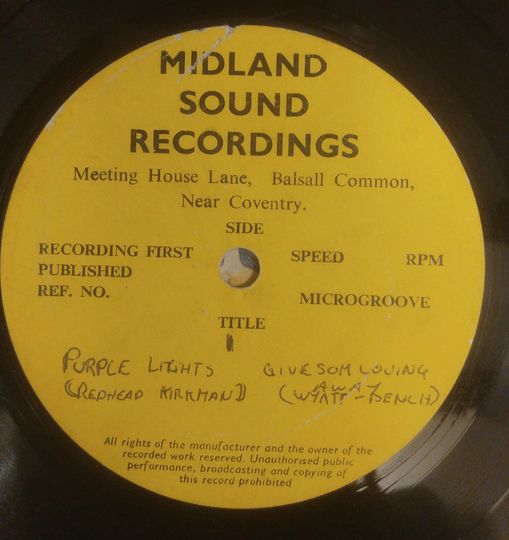
circa 1962 - now - Beat group - Line up: (early) Maurice Redhead (vocals), Terry Wyatt (guitar), Graham Peace (guitar), Nigel Lomas (drums).Wyatt joined The Sabres. Recorded 4 tracks at Midland Sound Recorders. Also associated Steve Jones, Olly Warner. They appeared on New Faces in 1977 singing the Steve Jones / Rod Bainbridge number Last Night We Called it a Day. The Zodiacs are still a going concern after all these years."

From Pete Chambers - Godiva Rocked to a Backbeat
" One of the hardest working bands in the area. They have been together nearly 50 years. Were one of the first few rock n roll bands in the city."
Pete Clemons has been consulting the stars again and has traced an alignment of Coventry musicians from the birth of Coventry music scene that appeared on TV in the 70's via New Faces. His latest article in the Coventry Telegraph takes a look at the music of the Zodiacs - a Coventry band that legends tell.of....


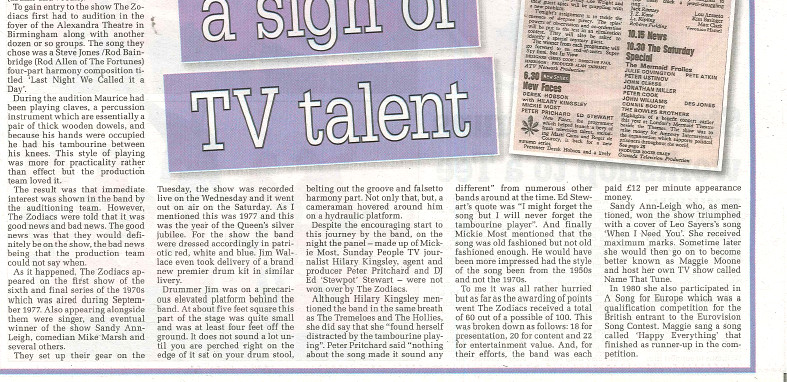
Zodiacs The of a Sign Talent TV.
by Pete Clemons.

AS has been widely documented recently, Coventry band The Zodiacs have enjoyed a remarkable 50 plus year career.

During that time the band has more than likely enjoyed many great and memorable moments together.

However, I am guessing that one of the biggest highlights must have been back in 1977 when they made an appearance on the television talent show 'New Faces'.

New Faces was famously associated with the 1970s where it ran for six series and was revived again during the 1980s for a further three series and was, arguably, the equivalent of what Britain's Got Talent stands for today. It was originally presented by Derek Hobson and the acts involved were evaluated by a panel of experts. The show was recorded and produced at the ATV Centre, Birmingham. The show also created a minor chart hit for its theme tune 'You're a Star!' performed by singer Carl Wayne, formerly of The Move.

Four judges make up the panel of experts who would discuss the acts. Contestants received marks out of ten from the four judges in three categories such as presentation, content, star quality and entertainment value. The act that had generated the highest total of points went through to the next round and ultimately a grand final.

Of course the programme would have a mix of praise and criticism and the most notorious of the critics were Mickie Most and Tony Hatch; this pairing was particularly renowned for being hard and brutal on the contestants. 

The line up of The Zodiacs at the time they appeared on the show was Maurice Redhead (vocals and tambourine), Terry Wyatt (lead guitar and vocals), Steve Jones (bass) and vocals and Jim Wallace (drums and vocals).

To gain entry to the show The Zodiacs first had to audition in the foyer of the Alexandra Theatre in Birmingham along with another dozen or so groups. The song they chose was a Steve Jones /Rod Bainbridge (Rod Allen of The Fortunes) four-part harmony composition titled 'Last Night We Called it a Day'.

During the audition Maurice had been playing claves, a percussion instrument which are essentially a pair of thick wooden dowels, and because his hands were occupied he had his tambourine between his knees. This style of playing was more for practicality rather than effect but the production team loved it.

The result was that immediate interest was shown in the band by the auditioning team. However, The Zodiacs were told that it was good news and bad news. The good news was that they would definitely be on the show, the bad news being that the production team could not say when.

As it happened, The Zodiacs appeared on the first show of the sixth and final series of the 1970s which was aired during September 1977. Also appearing alongside them were singer, and eventual winner of the show Sandy Ann-Leigh, comedian Mike Marsh and several others.

They set up their gear on the Tuesday, the show was recorded live on the Wednesday and it went out on air on the Saturday. As I mentioned this was 1977 and this was the year of the Queen's silver jubilee. For the show the band were dressed accordingly in patriotic red, white and blue. Jim Wallace even took delivery of a brand new premier drum kit in similar livery.

Drummer Jim was on a precarious elevated platform behind the band. At about five feet square this part of the stage was quite small and was at least four feet off the ground. It does not sound a lot until you are perched right on the edge of it sat on your drum stool, belting out the groove and falsetto harmony part. Not only that, but, a cameraman hovered around him on a hydraulic platform.

Despite the encouraging start to this journey by the band, on the night the panel - made up of Mickie Most, Sunday People TV journalist Hilary Kingsley, agent and producer Peter Pritchard and DJ Ed 'Stewpot' Stewart - were not won over by The Zodiacs. 

Although Hilary Kingsley mentioned the band in the same breath as The Tremeloes and The Hollies, she did say that she "found herself distracted by the tambourine playing".

Peter Pritchard said "nothing about the song made it sound any different" from numerous other bands around at the time. Ed Stewart's quote was "I might forget the song but I will never forget the tambourine player". And finally Mickie Most mentioned that the song was old fashioned but not old fashioned enough. He would have been more impressed had the style of the song been from the 1950s and not the 1970s.

To me it was all rather hurried but as far as the awarding of points went The Zodiacs received a total of 60 out of a possible of 100. This was broken down as follows: 18 for presentation, 20 for content and 22 for entertainment value. And, for their efforts, the band was each paid PS12 per minute appearance money.

Sandy Ann-Leigh who, as mentioned, won the show triumphed with a cover of Leo Sayers's song 'When I Need You'. She received maximum marks. Sometime later she would then go on to become better known as Maggie Moone and host her own TV show called Name That Tune.

In 1980 she also participated in A Song for Europe which was a qualification competition for the British entrant to the Eurovision Song Contest. Maggie sang a song called 'Happy Everything' that finished as runner-up in the competition.

Also
The Zodiacs 2009


From Pete Clemons - Coventry Telegraph 
http://www.coventrytelegraph.net/news/coventry-news/your-nostalgia-keresley-rock-fanatic-3036773
The ZODIACS were formed in 1959 by singer Maurice Redhead and Nigel Lomas. Also in the band were Terry Wyatt and Graham Peace.

Maurice and Nigel had met at a rock ‘n’ roll club during 1958 called The Drumbeat Club on Lockhurst Lane railway bridge on the Holbrooks side. It was a cellar club beneath a coffee bar.

Nigel would get up and sing there and have an occasional go on the drums. The only people I remember who also performed there were Mick Van de Stay, a singer and guitarist Jim Smith.

At this time there were only a few coffee bars that had music. The Milano on Radford Road and The Domino, Gosford Street, were two of them.

In 1960 when Eddie Cochran appeared at the Gaumont Cinema during January, he actually called in at the Milano after the show. The Zodiacs, incredibly, still perform today.


Nigel Lomas takes up the story: “I played drums for the Zodiacs from 1959-1962. The venues we played included: Collycroft Club, Bedworth most Thursdays; Newdigate Club, Bedworth, most Tuesdays; St George’s Hall, Nuneaton, most Saturdays, the Ritz cinema, Longford, on the odd Friday night or Sunday afternoon; the Stag and Pheasant, Lockhurst Lane, Sunday lunchtimes for about one year, maybe more, I cannot remember.

Other groups sharing the bill during these times were: Vince Martin and The Vampires, The Atlantics, who played at the Domino coffee bar, Gosford Street, Johnny and the Rebels, Max Holliman and the Guitarnos who were from Nuneaton.

“I left the Zodiacs in 1962 and was replaced by a very good drummer called Ron Cooke."

AND FROM PETE CHAMBERS


19th Feb 2009 Coventry Telegraph http://www.coventrytelegraph.net/lifestyle/nostalgia/zodiacs-50-years-as-stars-3086912

LOOK around at today’s bands and can you really imagine them still together in 50 years time?

Can’t see it myself, but back in 1959 some budding young musicians probably would have laughed at you if you had asked them the same question.

The amazing thing is those youngsters are still together and still called The Zodiacs.

Half a century on and two of the original members of the band Maurice Redhead and Terry Wyatt, are still out there playing, along with Terry Rye and Brian Bayton. Tomorrow night at Christ the King club, Coventry, Vince Holliday’s annual Backbeat Call up the Groups concert will be dedicated to the Zodiacs.

The band will perform a special set, that will include former members.

Terry said: “It’s been a great 50 years and we are looking forward to the next 50.

“We have made some good friends along the way and played with some top people. We are really looking forward to seeing many of the people we have played concerts for. We are hoping to have a lot of the past members on stage and take it from me, there’s been a few over the years.”

The band got together in 1959 when Cliff Richard was beginning his career as Britain’s answer to Elvis Presley, Buddy Holly died and Eddie Cochran was riding high with C’Mon Everybody.

Meanwhile, The Zodiacs who were Maurice Redhead, Nigel Lomas, Olly Warner Terry Wyatt and Graham Peace in those days, just had their first proper gig at the Stag and Pheasant on Lockhurst Lane.

They earned ‘50 Bob’ plus whatever was they had collected on ‘The Tray’ from Sunday lunch time sessions.

Local clubs beckoned and the band began to play the likes of The Stanton, Cox Street and The Limetree Walsgrave.

In 1977 the band were spotted by the producers of TV’s talent show New Faces. They appeared on the show singing the original song “Last Night we Called It A Day” composed by band member Steve Jones and late Rod Bainbridge of the Fortunes.

The show was full of problems, including a light failure during their number.

When they did get to play the show’s producer liked the way front man Redhead played the tambourine between his legs!

Against the band’s better judgment, the producer persuaded them to all do it and predictably they were savaged for it.

The comments they received that day did nothing to diminish their enthusiasm and the band continued to go from strength to strength.

Tomorrow’s concert starts at 8pm and entrance costs £1. Also on the bill will be 60s favourites Woody Allen and the Challengers, Johnny Ransom and the Rebels and the Mad Classics and the Phoenix Rock n Roll band.
....................................................................


Zodiacs 1964 Memorial Hall


From Ian Green of Broadgate Gnome site.

4 track EP by Zodiacs recorded at Midland Sound Studios Balsall Common Coventry

Sound clips from a gig in 1981 featuring Terry Wyatt, Maurice Redhead, Steve Jones and Jim Wallace.

Comment from youtube 

teg33
"They bring back great memories from Fiday nights at the London rd club,Cov. O' happy days !!!"

Tuesday, July 23, 2013

Coventry's Rock n Roll Cafes

Pete Clemons winds down with an 'Expresso' and the Summertime Blues (Eddie Cochran style) for his latest article for the Coventry Telegraph. This time around, he takes us on a tour of the Rock n Roll Coffee bars and cafes in 1950's Coventry - but don't tread on his Blue Suede Shoes!!


Two sugars and a gig please!
Pete Clemons 

THE coffee bar boom began in Britain during the early 1950s with the arrival of the first espresso machine in Soho, London.

Essentially cafes, they were Italian or American themed and full of amusements like pin ball machines.

Eventually coffee bars became an alternative to the teenage youth club and were ideal for use as meeting places for the like minded youngsters who would hang out in them.

In greater London alone over 500 of them sprang up during the early Fifties and throughout the rest of the decade. And they did not just stay in London as coffee bars continued to spread throughout the UK.

They were mainly independent which gave them that individual and unique touch. They were furnished with the cheapest Formica or plastic products available, they were rough and ready and yet, for more than twenty years, coffee bars were full of life, music, humour and were incredibly popular places.

They touched all the major towns and cities the length and breadth of the country seemed to have them. And Coventry, with its apparent abundance of coffee bars, was no different.

Despite a negative attitude towards them, by the elders at the time, coffee bars and cafes became significant places and played an important role in the birth of, firstly skiffle, then rock 'n' roll and also the mod/rocker culture within the UK.

In fact the arrival of rock 'n' roll in the UK led to a lot of coffee bars becoming exclusive to and revolving around that genre of music. Some began to set aside an area for a juke box in order to play the new hit singles. There may even have been an area for dancing and maybe even one of the many bands that were now springing up influenced by this exciting form of music would get up and perform live in one.


In Coventry during the late 1950s and early 1960s there was quite a variety of cafes and coffee bars along and around Gosford Street. A good few of them were sympathetic and supportive of this up and coming music scene. Some that spring to mind were The Domino, The El Cabana, The Rendezvous, Gigi's, La Tropicale and The Sorrento.

Other significant coffee bars about at that time, and in other parts of the city, that also catered for music included The Beaker on Beake Avenue, The Portofino Expresso on Primrose Hill Street, The Godiva in Jordan Well, The Corner Cafe and The Dreadnought both on Radford Road.

And then there was The Bridge Cafe on the railway bridge where Lockhurst Lane and Holbrook Lane meet. It has been mentioned that it was in this venue that one of Coventry's earliest bands, The Zodiacs, were formed in 1959 by singer Maurice Redhead and drummer Nigel Lomas. A cafe with a similar name still exists on the bridge today.

The pair had met there in 1958 at a rock 'n' roll club held at the Bridge Cafe called The Drumbeat Club. The club itself was situated to the rear and downstairs under the bridge and it was an incredibly music friendly place as it attracted musicians and singers.

Another important coffee bar venue was The Milano on Radford Road. I have it on good authority that Eddie Cochran visited the venue after the concert he and Gene Vincent had given at The Gaumont on the January 28, 1960.

The Milano had a very lively music scene with regular live appearances by bands like Ronnie Wilde and the Wildcats, Clive Lea and the Phantoms, The Zodiacs, The Vampires and The High Cards.

It used to advertise regularly as 'the cafe bar with a difference'. The place even had a house group named after it, The Milano Rockers.

But where this cafe would really excel was when, for example, a name artist was visiting the city. The Milano would get them to appear at The Milano during that afternoon prior to the main gig that they had been in the city to play. This happened when Georgie Fame, for example, was due to play an evening show at The Rialto and when Johnny Gentle played at The Banba Club and I understand that this happened on several other occasions.

Don Fardon remembers well, a cafe, which used to be up on Ball Hill. It was called Margaret's and was across the road from St Margaret's Church. In fact the building now known as the Churchill Hotel, the Old Ball Hotel and Margaret's Cafe were all owned by a Greg Rogan. This one stayed open late and was frequented by a lot of groups used to frequent Margaret's.

I mention the word cafe as opposed to a coffee bar. The best way I can describe the difference was that a cafe sold full meals as well as tea, coffee and sandwiches where as a coffee bar was more of a specific business where you could only buy coffee along with maybe cakes, pastries etc.

Another reason for mentioning those distinguishing features was because, as Mod culture took hold of the country in the early 1960s, it made a great deal of difference with the Mods tending to prefer the coffee bar while Rockers generally preferring to hang out in cafes, in particular transport cafes.

The landmark roadside transport cafe known as 'Bob's caf', out on the A45 at Stretton-on-Dunsmore, was a particular favourite with the bikers. Always open until the early hours it attracted bikers from far and wide. Abandoned for almost twenty years, it served up a great atmosphere as well as a tremendous breakfast. Now flattened and currently with a new building project in progress I bet it holds a lot of memories for some.

A few years ago the Coventry Transport Museum reproduced London's iconic biker's cafe, 'The Ace Cafe', for a summer exhibition it was running. It also defined what cafe's meant to teenagers of 50 years ago.

And even today the cafe culture still exists. Maybe not so many of them but they are still there. The indoor market has several and the 2-Tone centre on Ball Hill is even one that combines music and good food.


Thursday, July 18, 2013

Porcupine Tree

Well, Pete Clemons has chalked up 50 articles for the Coventry Telegraph with this article!!! Well done Peter.

This is not a Coventry band but Coventry comes into the picture at some stage and is favourite band of Pete Clemons, who has chosen to focus on them for this landmark article. It's an amazing musical story as the band didn't even exist at first but....(no spoilers I'm afraid - read the article..).


Porcupine's Steve Living his Fantasy.
 Pete Clemons 

IT may have escaped some people that British band leader, song writer and producer Steven Wilson recently received his fourth Grammy nomination in the "Best Surround Sound Album" category for an album called 'Storm Corrosion', an album he jointly collaborated with Mikael Akerfeldt of Swedish rock band Opeth. In fact all of his previous three nominations were in the same surround sound category.

Steven Wilson is a pioneer in the field of 5.1 Surround Sound, commonly used by cinemas, but nowadays being preferred by a lot of music listeners. He was previously recognised for Porcupine Tree's 2007 album 'Fear of a Blank Planet', their 2009 release 'The Incident' and the magnificent 'Grace for Drowning' album that Steven released under his own name during 2011.

My own introduction to Steven was around 1989/90 when he was creating music and releasing cassettes of his work through a magazine called Delerium. The roots of this music actually date back several years earlier. A lad who I worked with back then had recommended the tapes to me by initially lending me his copies. I was immediately hooked and subsequently ordered copies of the tapes for myself.

The cassettes came with pamphlets that introduced you to the various band members of a legendary band called The Porcupine Tree. They gave you a brief history of the band, information about where the tracks had been recorded and what festivals the band had performed at. However, it soon became apparent that all this information was a complete work of fantasy and The Porcupine Tree were in fact a fictitious band.

Now don't get me wrong, this was not fantasy of the sinister kind. This was simply a couple of young lads from Hemel Hempstead, Steven and his school friend Malcolm Stocks, who both had incredible imaginations and who probably never imagined or realised at that time the huge interest all this stuff would create.

Promoted by word of mouth those early cassettes soon sold out and Delerium quickly realised they had something rather special on their hands so Steven set about remixing and re-recording some of the tracks from those early cassette tapes. The result was that in July 1991 Porcupine Tree released their debut album 'On the Sunday of Life' on the Delerium record label.

It was a lavish double LP complete with gatefold sleeve.

This was followed up in May 1993 by the 'band's' second album 'Up the Downstair'. Apparently this release was also to have been another double LP release which was due to include the 34 minute CD single called 'Voyage 34' that had been released during 1992.

But in the end it was released as a single LP. Up the Downstair also included other musicians other than Steven. Namely Colin Edwin on bass and Richard Barbieri on keyboards Talk began of the possibilities for the band to play live. Late 1993 saw them recruit drummer Chris Maitland and on December 4 Porcupine Tree made their concert debut upstairs at The Nags Head pub in High Wycombe. The event sold out very quickly pulling in people from all over the country.

A free monthly magazine, that existed at the time in and around Coventry called Deliverance, had picked up quite early on the band and had taken a keen interest by publishing album reviews and conducting an interview with Steven Wilson. Whether this led to the gig or not I do not know but a week after the High Wycombe gig, on Saturday December 11, Porcupine Tree appeared in Coventry at Antics Club, formerly known as the Tic Toc Club.

However, the band had hit a problem in as much that keyboard player Richard Barbieri was unavailable for the gig. So the show went ahead as a three-piece lineup, Rather than play their expected set, the band simply improvised, by performing their ambient/techno/trance track Voyage 34 for the entire evening. This was a time when Coventry was gripped by rave music and venues like the Eclipse nightclub were at the very forefront of that scene. The crowd lapped it up and the evening was a great success. To my knowledge this was the only occasion the band has ever played as a three-piece.

1994 saw the band establishing itself on the live circuit and further gigs ensued, not just in the UK but also on the continent. It also saw the band record their next album 'The Sky Moves Sideways' which was released in February 1995. This was the first Porcupine Tree album to involve the whole band and the first to include real drums.

April 1995 saw the band return to Coventry. This time the gig was at The General Wolfe pub and this time a full set was performed that was built around and showcased Porcupine Tree's recently released third album. It was a stunning gig which again played to a large enthusiastic audience.

To date Porcupine Tree, albeit with a slightly different line-up, have released a total of 10 studio albums along with many live recordings, special editions and other spin-offs. They also have a different record label and management. Porcupine Tree gigs have spread too far off places like the US, Australia and India. In the UK they have performed in grand venues such as the Royal Albert Hall.

Steven Wilson has just released his third critically acclaimed solo album 'The Raven That Refused To Sing'. Another world wide tour has been announced. Over the years he has been involved in many other bands and musical projects, both as musician and producer that include No-Man and Blackfield.

He is also incredibly well respected in the field of re-mixing and has been entrusted with the back catalogue of classic 1970s albums such as those by King Crimson, Caravan, ELP, Family and Jethro Tull.

Having followed Steven Wilson's career as best I can for over 20 years, watching his rise from the humble beginnings of producing and selling homemade cassettes through to the grandeur of today's special editions that accompany each of his releases, has been fascinating.

His dedication to, and the risks he has taken for his art which in turn is for those who enjoy it all, have been truly inspirational.

Surly that illusive Grammy award is not too far away.

It all leaves me to wonder if those pamphlets that were given away free with those early cassette releases, that spoke of this legendary band, do now seem to have been some kind of prophecy as they appear to have turned into reality.


Much more from Porcupine Tree and Steve Wilson on youtube.......